Every FBA cost guide obsesses over the referral fee and the fulfillment fee — the per-unit charges you see when a product sells. But the fees that quietly turn a profitable product into a loss are the ones charged whether it sells or not: storage. They triple in Q4, they escalate the longer stock sits, and — the part that catches sellers out — they stack. Here’s how Amazon FBA storage fees actually work in 2026.
The base fee that triples in Q4
You pay a monthly inventory storage fee just to keep units in Amazon’s warehouses, priced per cubic foot — and it’s not flat across the year.
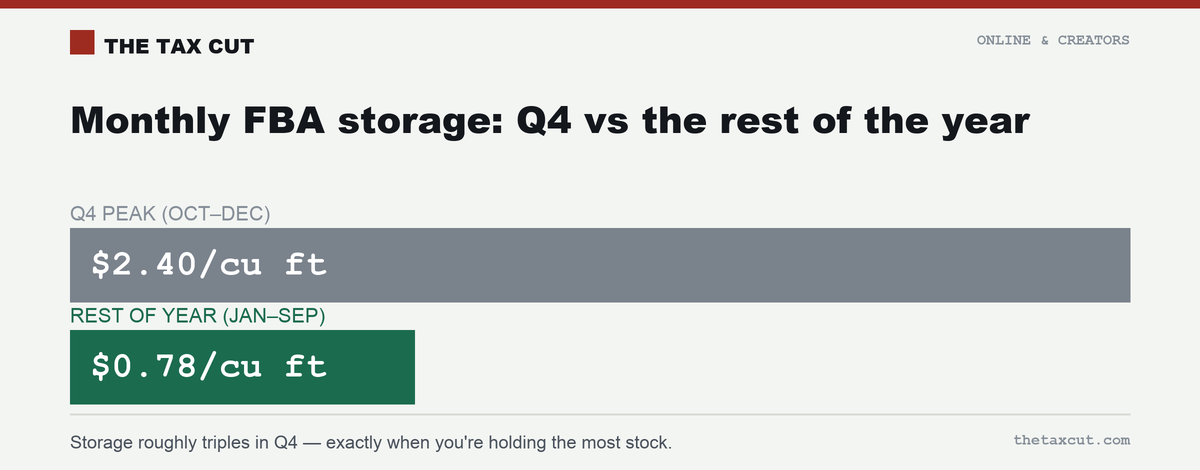
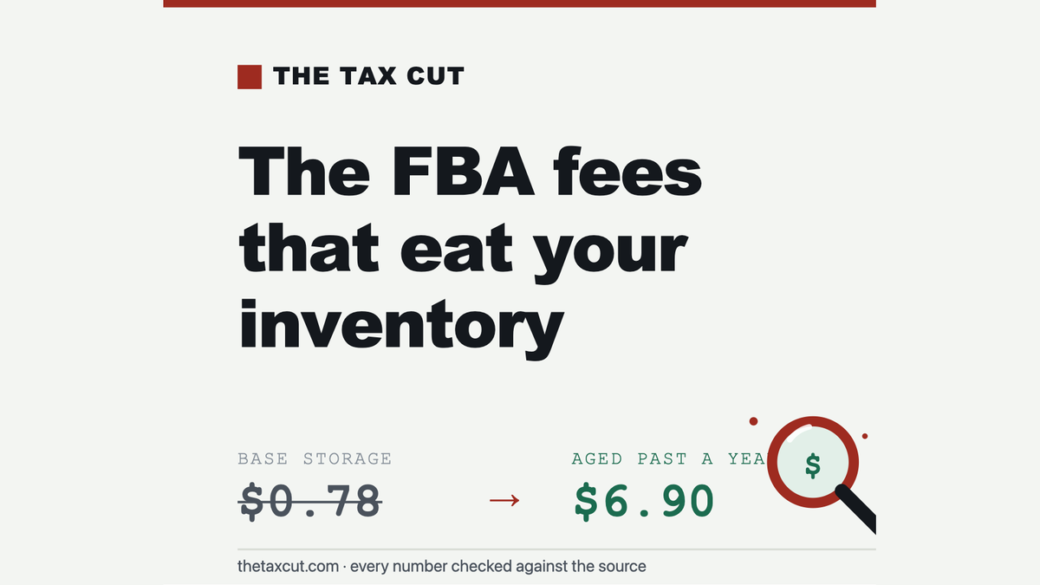
For standard-size items it’s about $0.78 per cubic foot from January through September, then jumps to $2.40 per cubic foot in October–December — right when you’re holding the most stock for the holidays.
Source: Amazon Seller Central — Monthly inventory storage fees · checked 2026-07-29
That Q4 spike is deliberate: warehouse space is scarcest exactly when you want to stockpile, so the cost of guessing wrong on quantity is highest in the fourth quarter.
The aged-inventory surcharge that punishes slow sellers
Here’s the one that liquidates businesses. On top of the monthly fee, Amazon charges an aged-inventory surcharge on stock that sits too long — and in 2026 the clock starts at just 181 days (it used to be 271).
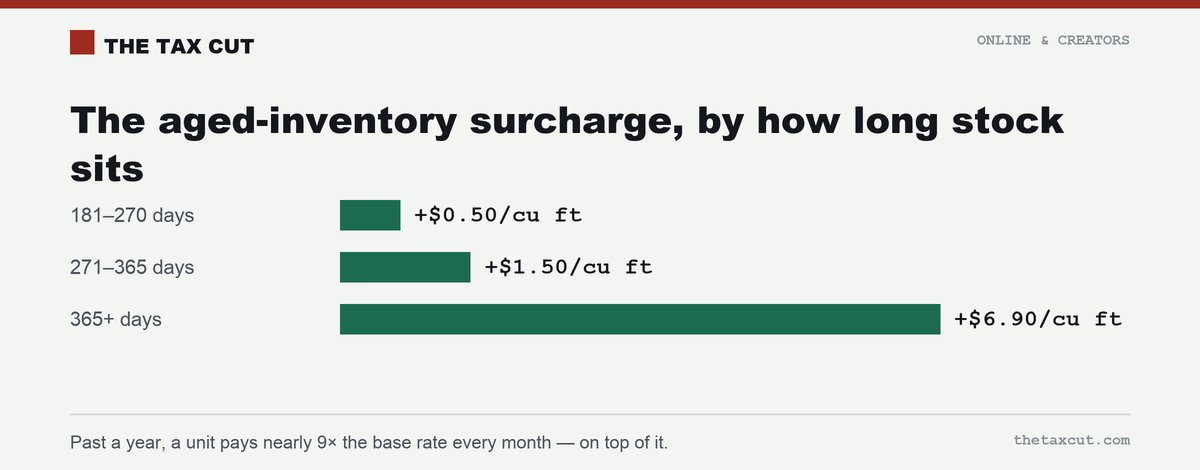
- 181–270 days: +$0.50 per cubic foot / month
- 271–365 days: +$1.50 per cubic foot / month
- 365+ days: +$6.90 per cubic foot / month
A unit stuck past a year is paying nearly nine times the normal base rate, every month, on top of it. That’s why sellers liquidate slow stock at a loss rather than let it age — the surcharge outruns the product’s value.
Source: Amazon Seller Central — Aged inventory surcharge · checked 2026-07-29
The two surcharges nobody plans for
Even fresh, fast inventory can trigger fees if you send too much:
- Storage utilization surcharge. Hold more than ~22–28 weeks of supply and a surcharge kicks in — from $0.44 per cubic foot up to $1.88 above 52 weeks of supply. Overstock, and you pay for the privilege.
- Low-inventory-level fee. Send too little, and Amazon charges the opposite fee: if you consistently hold under ~28 days of supply, a low-inventory-level fee applies. There’s a narrow “just right” corridor, and both walls cost money.
Why they hurt: the fees stack
The trap isn’t any single fee — it’s that a single overstocked, aged unit can be hit by three or four at once: the base monthly fee (at the Q4 rate), the aged surcharge, and the utilization surcharge, all in the same month. That’s how a product that looked profitable on the per-unit calculator bleeds out in storage while it waits to sell.
The lesson every experienced FBA seller learns the expensive way: **your fulfillment fee is a cost of selling; your storage fee is a cost of guessing wrong.** Order too much, sell too slow, or stock up for a Q4 that underperforms, and storage quietly takes the margin the fulfillment fee left you.
How to keep storage from eating you
- Send less, more often. Match inventory to real sell-through, not hope — stay inside the 28-day-to-6-month corridor.
- Watch the 181-day clock. Set a reminder well before stock ages; a removal or disposal order submitted before the monthly cleanup date avoids that month’s aged surcharge.
- Respect Q4. Only send holiday stock you’re confident will clear by December — unsold Q4 inventory pays the $2.40 rate and starts aging into January.
- Liquidate early, not late. A small loss now beats a $6.90/cubic-foot bill later.
Storage fees are the quiet difference between FBA sellers who scale and ones who drown in their own warehouse. Price them in before you send the shipment, not after.
People also ask
How much are Amazon FBA storage fees in 2026?
About $0.78 per cubic foot per month (standard size) from January–September, rising to $2.40 in Q4 (Oct–Dec), plus possible aged-inventory and utilization surcharges on top.
Source: Amazon Seller Central — Monthly storage fees · checked 2026-07-29
What is the FBA aged-inventory surcharge?
An extra fee on stock stored 181+ days: +$0.50/cu ft (181–270 days), +$1.50 (271–365), and +$6.90/cu ft/month past a year — on top of the normal monthly storage fee.
Source: Amazon Seller Central — Aged inventory surcharge · checked 2026-07-29
How do I avoid FBA long-term storage fees?
Keep inventory turning inside the ~28-day-to-6-month window, watch the 181-day age clock, and submit a removal or disposal order before the monthly cleanup date to skip that month’s surcharge.
Why are my FBA fees higher in Q4?
The monthly storage rate roughly triples (to $2.40/cu ft) in October–December because warehouse space is scarcest during the holidays, exactly when sellers stock up most.
See it for your own numbers
Every calculator shows revenue. This one shows what lands.
Related on The Tax Cut
- How much do sneaker resellers actually profit? — another inventory business where fees decide the margin.
- Amazon affiliate: orders but no earnings? — the other side of Amazon’s fine print.
- Are low-content books worth it in 2026? — a lower-overhead way to sell on Amazon.