Turo’s pitch is one clean number: keep up to 90% of every trip. For a car sitting idle in your driveway, 90% of anything sounds like free money. And in January 2026 Turo reshuffled the whole system — renaming “protection plans” to earnings plans — which made the number look even friendlier.
But “90%” is not a rate you’re handed. It’s a choice, and the thing you trade for it is the exact thing that decides whether hosting is worth it: how much of a wreck, a claim, or a slow month lands on you instead of Turo. So let’s answer the real question — is being a Turo host worth it in 2026 — the way we answer every one: with the official numbers, then the costs the earnings estimate leaves out.
What Turo actually changed in 2026
Two things happened this year, and both matter for take-home.
First, on January 7, 2026, Turo moved US hosts onto streamlined earnings plans — you pick how much of the trip price you keep, and the more damage protection Turo carries, the smaller your share. Liability coverage stayed at up to $750,000 across every plan.
Source: Turo Help — Earnings plans, in brief (US hosts) · checked 2026-07-28
Second, Turo tilted the whole marketplace toward advance and longer bookings. Hosts on the top earnings plan can capture 100% of the trip price on trips booked 28+ days ahead, and a standardized 10% non-refundable discount now applies to trips booked 4+ days out.
Source: Turo — Key updates shaping the marketplace in 2026 · checked 2026-07-28
Read that carefully. The generous numbers are attached to the predictable bookings — plan ahead, rent longer — and the last-minute, high-turnover hosting that many people imagine is quietly the least rewarded.
The 90% that isn’t 90%
Here’s where the official calculator stops. Your share of the trip price is not your profit. Take a car listed at $50/night, booked 12 nights in a month.
$50/night Trip price12 Nights booked$600 Gross trip income$450 Your 75% share
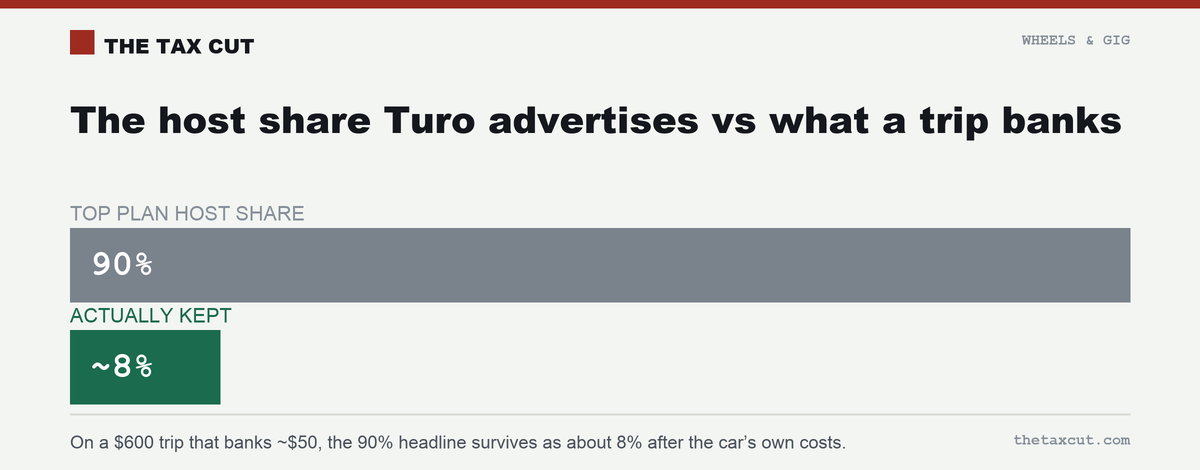
On a middle earnings plan you keep roughly 75% — so Turo’s cut is about $150 of that $600, in exchange for carrying more of the damage risk. Pick the 90% plan and you keep $540 instead — but you’ve just agreed to a far higher deductible if anything goes wrong. That trade is the single most important decision a Turo host makes, and it never shows up in the “you could earn $X” estimate on the listing page.
Source: Turo — Introducing earnings plans (share vs. protection trade-off) · checked 2026-07-28
The four lines the earnings estimate never adds
Start from that $450 and keep subtracting the things a real host pays.
1. Depreciation and mileage. the cost hosts feel last Every renter puts miles on your asset. On a typical car, each mile is worth roughly $0.15–$0.20 in lost value and wear. A 12-night month can easily add 1,500+ renter miles — call it $225–$300 of value quietly leaving the car. This is the cost that makes profitable-looking hosts sell at a loss two years later.
2. Cleaning and turnover. A car has to be detailed between trips. Do it yourself and it’s unpaid hours; pay a detailer and it’s $25–$50 per turnover. Twelve nights across, say, four separate trips is four turnovers.
3. Gas, tolls, and the top-off gap. Renters return cars below the fuel line more often than above it, and reimbursements rarely cover the real cost plus your time collecting them.
4. The claim you can’t schedule. This is the one that decides “worth it.” When a renter damages the car, two things happen at once: you pay your plan’s deductible/excess, and the car earns nothing while it sits in the shop for days or weeks. Pick the 90% plan for the bigger share and a single bad claim can erase a quarter of hosting.
Source: Turo 2026 coverage, exclusions & excesses — host guide · checked 2026-07-28
Claimed against banked
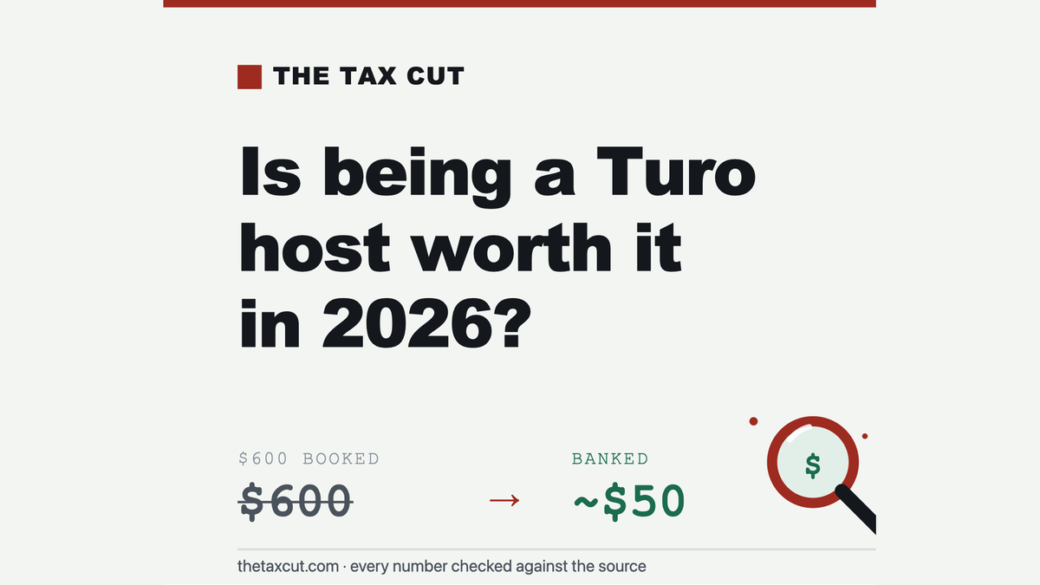
Put the illustration together for that 12-night month, on the 75% plan, on a paid-off economy car. illustration; your car and market will differ
$450 Your 75% share−$260 Depreciation/mileage−$140 Cleaning ×4≈$50 Banked (no claim)
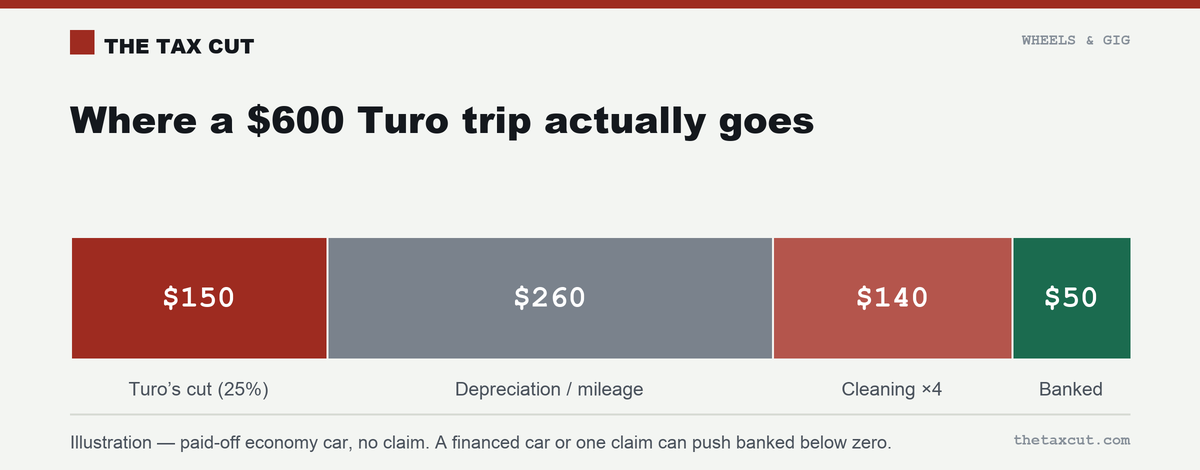
In a clean month with no damage, a $600 top-line becomes roughly $50 of real profit on a paid-off car — and a loss on a financed one, because the loan payment lands whether the car rents or not. The months you don’t have a claim are the good months. That’s the honest shape of it.
So is Turo worth it in 2026?
It can be — but only under conditions the marketing doesn’t emphasize:
- A paid-off, cheap-to-own car. Financing or a luxury vehicle turns depreciation and a single claim into a hole you rent your way into, not out of.
- The right earnings plan for your risk tolerance. The 90% share is only “more earnings” until the first bad renter; a lower share with real protection is often the higher expected take-home.
- Advance and longer bookings, which is exactly what Turo’s 2026 changes now reward — and what turns hosting from a turnover grind into something close to passive.
- Multiple cars. The economics only start to resemble a business when volume absorbs the dead weeks and the occasional claim.
For one paid-off economy car booked steadily and hosted carefully, Turo in 2026 is a modest side income — think tens of dollars a night banked, not the trip price you see on the listing. For a financed car chasing last-minute rentals, the plan changes made an already-thin model thinner. The trip price is not the paycheck. What you keep after the plan, the miles, and the one claim you can’t schedule — that’s the paycheck.
People also ask
How much do Turo hosts actually make per month?
It depends entirely on the car and the plan. On a paid-off economy car booked ~12 nights, a $600 top-line becomes roughly tens of dollars per night banked after your plan’s cut, depreciation, and cleaning — not the trip price you see on the listing. A financed car can net a loss.
What are Turo’s 2026 earnings plans?
In January 2026 Turo renamed “protection plans” to earnings plans. You choose how much of each trip you keep (roughly 60% up to 90%); the more damage protection Turo carries, the smaller your share. Liability stays at up to $750,000 across all plans.
Source: Turo Help — Earnings plans, in brief · checked 2026-07-28
Does Turo cover depreciation?
No. Every renter mile wears down your asset — roughly $0.15–$0.20 in lost value per mile — and none of it is reimbursed. It’s the cost that makes profitable-looking hosts sell at a loss later.
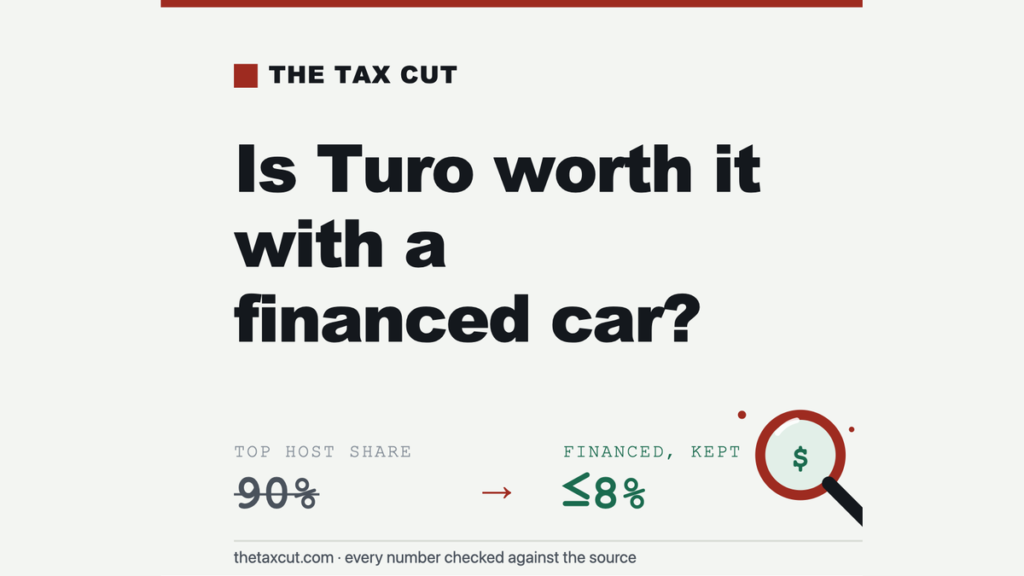
Is Turo worth it with a financed car?
It’s the riskiest setup. The loan payment is due whether the car rents or not, and a single claim’s deductible plus downtime can erase months of hosting. Turo works best on a paid-off, cheap-to-own car.
See it for your own numbers
Every calculator shows revenue. This one shows what lands.
Related on The Tax Cut
- How much do Rover sitters actually make? — the visible platform fee is never the real cost.
- How much does DataAnnotation actually pay? — an advertised rate versus the effective one.
- What does an Airbnb host actually keep? — another asset that earns less than its top-line suggests.