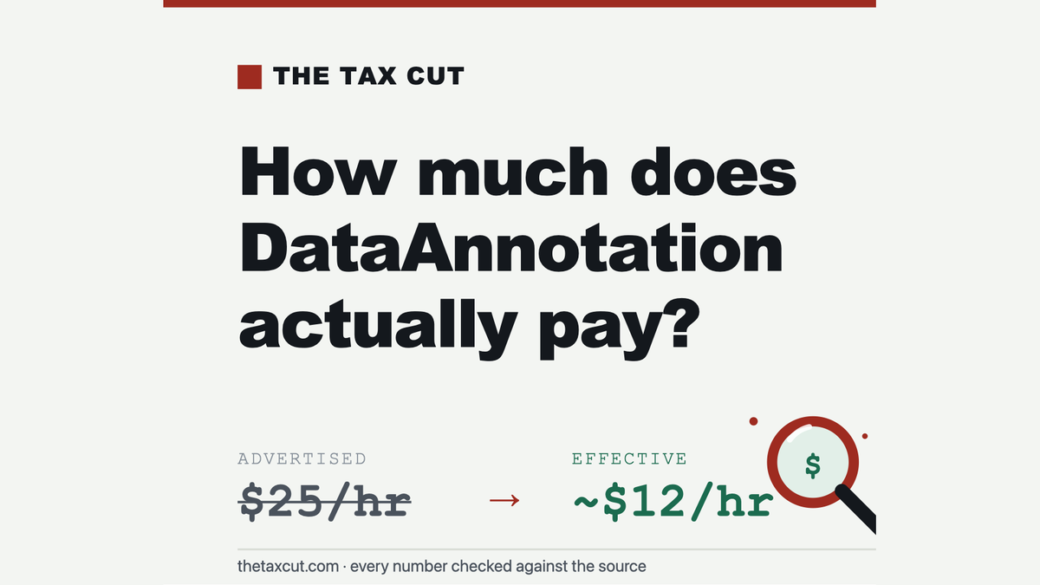
Search “DataAnnotation” and the top of the page tells you the same comfortable number every time: $20 an hour and up, sometimes $50–$100 for coding. Type the same word into Reddit and the question changes completely. There, people aren’t asking what it advertises. They’re asking why their PayPal doesn’t match it — why the assessment took ninety minutes for nothing, why they passed and still have no work, why a “$25/hr” week came out closer to twelve.
That gap is the whole story, and no rate card explains it. So here it is, the way we do every number on this channel: the advertised rate, then the hours it quietly leaves out, then what actually lands in the account.
What DataAnnotation says it pays
Start with the official figures, because they’re real. DataAnnotation is not a scam, and the rates on its own site are not invented.
$25–30+/hr General projects$20+/hr Multilingual$50–100+/hr Coding$50–100+/hr STEM / professional
Those are the platform’s stated starting rates by track, and payment is real too: it goes out by PayPal, “within a few days” after you request it.
Source: DataAnnotation — Help / FAQ (rates and payment) · checked 2026-07-28
If every hour you spent on the platform were a billable hour at those rates, DataAnnotation would be one of the best-paying remote gigs on the internet. That “if” is doing an enormous amount of work.
The hours that pay nothing
Here is where the official calculator — the rate card — stops. It should not.
1. The assessment. Before you earn a cent, you take a starter assessment. It runs around 90 minutes, and it is unpaid. reported across reviews That’s not unusual for skilled gig work, but it’s the first hour-and-a-half the “$25/hr” figure silently assumes away.
2. The qualification tests. Passing the assessment does not hand you paid work. It hands you more tests — project-specific qualifications, also unpaid — that decide which paid projects you can even see.
Source: Trustpilot — DataAnnotation reviews (unpaid qualification steps) · checked 2026-07-28
3. The wait. The site says decisions take “a few days.” Reviewers routinely report two weeks, sometimes a month, with no reply — a stretch where you’ve done the work and can’t tell if you’ve been hired.
Source: Glassdoor — DataAnnotation reviews (approval timelines) · checked 2026-07-28
4. Task-hunting. This is the big one, and it never appears on any pay page. Even after you’re approved, work is not waiting for you. You log in, refresh, check the dashboard, and often find nothing in your queue — because availability depends on “both the demand for your skills and your past performance on the platform.”
Source: DataAnnotation — FAQ (work availability depends on demand and performance) · checked 2026-07-28
The minutes you spend looking for a task are as unpaid as the ones you spend doing one.
A realistic week, line by line
Put a number on it. Take an approved worker on the general track at the platform’s own $25/hr, in a normal week — not a first week, not a dry spell.
Say the dashboard offers 6 billable hours of tasks that week. To catch them, they log in across several days and spend about 2 hours refreshing, reading instructions, and checking for new work that pays nothing. illustration, not a platform figure
6 Billable hours$25/hr Rate$150 Gross8 Hours actually spent
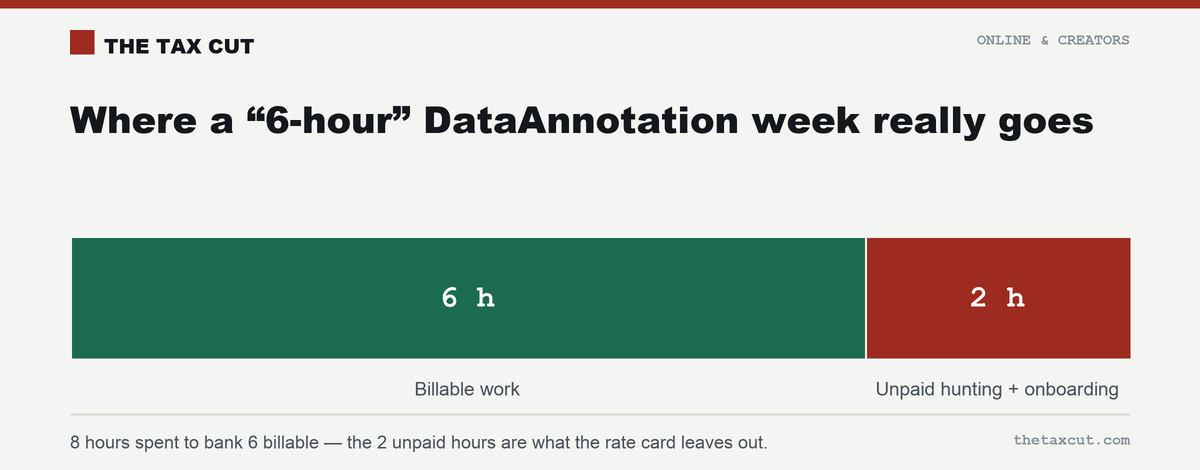
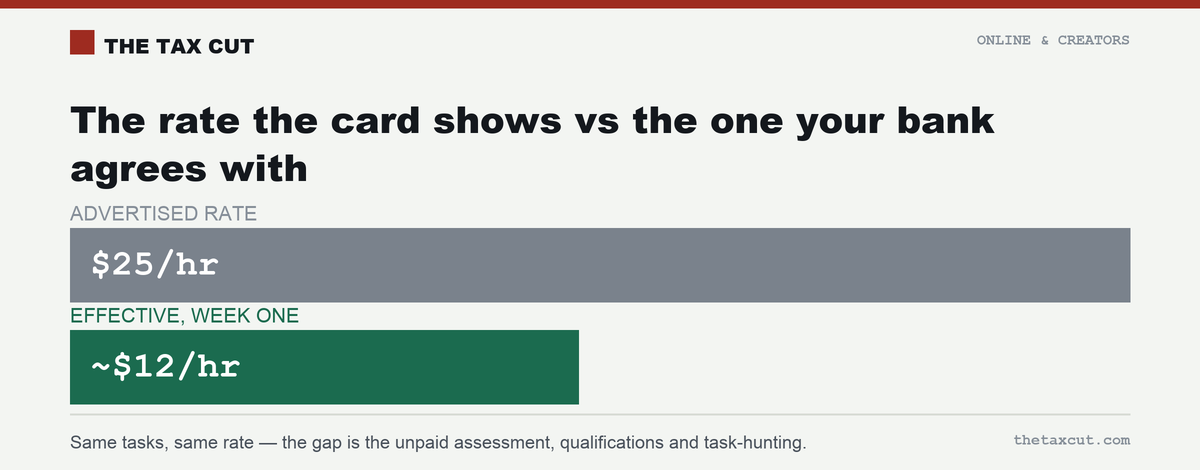
The gross is exactly what the rate card promised: 6 × $25 = $150. But the time it cost was 8 hours, so the effective rate is about $18.75/hr — before the first week’s unpaid onboarding, which drags a beginner’s opening week down near $12/hr once the 90-minute assessment and a couple of qualification tests are counted.
Nothing here is fraud. Every task paid its stated rate. The distance between $25 and $18.75 — or $12 in week one — is made entirely of hours the rate card doesn’t count.
Why the effective rate swings so hard
Two things decide whether your week looks like $18/hr or $5/hr, and neither is under your control.
Work is intermittent by design. DataAnnotation is a marketplace, not an employer. It advertises “thousands of active projects,” but any single worker only sees the slice their qualifications and performance unlock — and that slice can dry up for days.
Source: DataAnnotation — “Does Data Annotation Pay Well?” (availability by demand) · checked 2026-07-28
A week with 20 billable hours and a week with 2 pay the same rate; they pay wildly different incomes.
The friction is unpaid. Slow communication, occasional submission bugs, and re-qualification when projects change all cost time you can’t bill. Reviewers who love the pay and reviewers who feel burned usually agree on this one point: the rate is good, the consistency is not.
That’s why honest write-ups keep landing on the same verdict — this is “useful side income with friction,” not a reliable remote job. Broader gig-platform research makes the same warning in stronger terms: once idle and unpaid time is counted, a large share of gig workers clear less than minimum wage on an effective basis.
Source: Factually — data-annotation earning sites (effective-pay caveat) · checked 2026-07-28
So — is DataAnnotation legit, and is it worth it?
Legit: yes. It pays what it says per task, it pays through PayPal, and the rates are genuinely high for remote work. If you have a coding or STEM background, the $50–$100/hr tracks are among the best-paying online gigs a non-employee can access from a laptop.
Worth it depends entirely on how you treat two truths at once:
- As a rate, it’s excellent.
- As an income, it’s unpredictable — you cannot promise yourself a fixed weekly number, because the platform can’t promise you a fixed number of tasks.
Treat it as a top-up you fit around other work, and it’s one of the better options out there. Treat it as a salary replacement, and the unpaid hours — the assessment, the qualifications, the task-hunting, the dry spells — will quietly turn a headline rate into something far more ordinary.
How to check your own effective rate
Before you decide DataAnnotation “pays $25/hr,” measure it the way it actually spends. For one week, run a timer on everything: assessments, qualification tests, logging in and hunting, reading instructions, and the tasks themselves. Then divide your total PayPal payout by all of those hours — not just the billable ones.
That single division is the number the rate card will never show you, and it’s the only one your bank account agrees with. Every gig on this site is measured the same way — the advertised number versus the one that survives to your account.
People also ask
Is DataAnnotation legit or a scam?
Legit. It pays what it advertises per task, pays through PayPal, and the rates are genuinely high for remote work. The complaints aren’t about fake pay — they’re about availability: unpaid onboarding, dry spells, and slow communication.
Source: DataAnnotation — Help / FAQ · checked 2026-07-28
How long does DataAnnotation take to pay?
Once you request a payout, it lands in PayPal “within a few days.” The catch is getting there — earnings have to accumulate first, and slow weeks mean the balance builds slowly.
Why do I have no work on DataAnnotation?
Because the platform is a marketplace, not an employer. Work you can see depends on “demand for your skills and your past performance,” so queues run dry for days at a time even for approved workers.
Is the DataAnnotation assessment paid?
No. The starter assessment (about 90 minutes) is unpaid, and passing it unlocks further unpaid qualification tests before any paid project opens.
Can you make a living on DataAnnotation?
As a rate, it’s excellent. As an income, it’s unreliable — you can’t promise yourself a fixed weekly number because the platform can’t promise you a fixed number of tasks. Treat it as a top-up, not a salary.
See it for your own numbers
Every calculator shows revenue. This one shows what lands.
Related on The Tax Cut
- How much do Rover sitters actually make? — the platform cut you can see, and the on-duty hours you can’t.
- Why most affiliate marketers make nothing — another online-income headline that shrinks before it reaches the bank.
- Is Turo worth it in 2026? — the same gap between an advertised rate and what actually lands.