
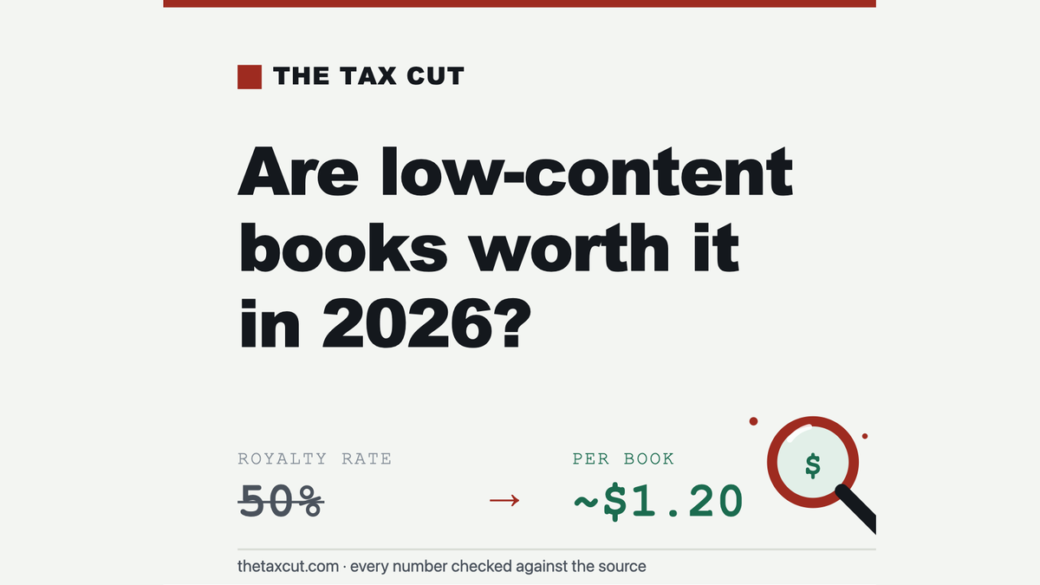
Low-content books — journals, planners, logbooks, puzzle titles — were sold for years as the ultimate passive-income shortcut: upload a PDF, collect royalties forever. In 2026 that pitch is mostly dead, but the income isn’t. The honest answer is that low-content publishing still works — for a completely different kind of publisher than the one the gurus described.
The per-book reality hasn’t changed — it’s just thin
Start with the math, because it’s the same unglamorous number it always was. A typical $6.99 low-content paperback earns you about $1.20 after Amazon’s cut and printing.
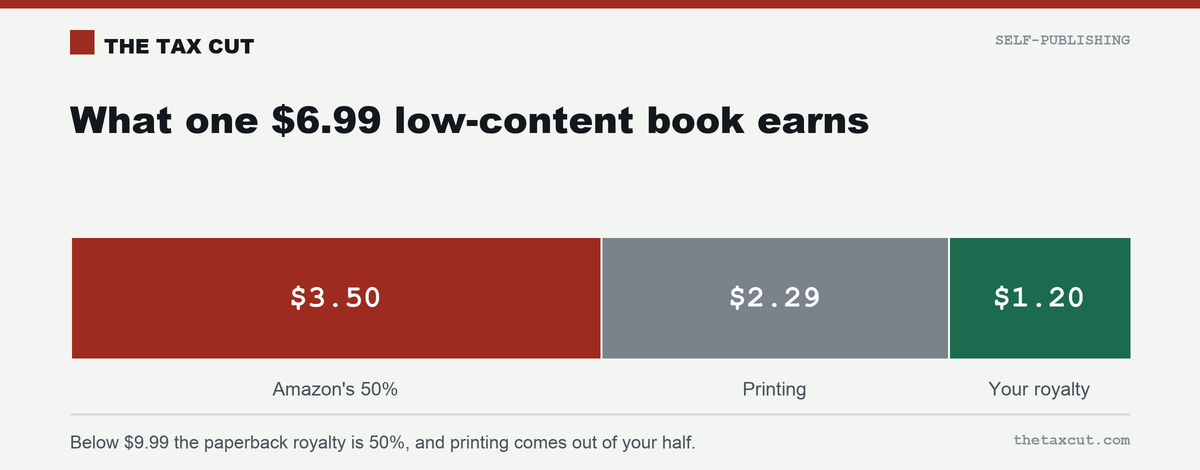
Below $9.99, KDP pays a 50% paperback royalty, and the printing cost comes out of your half — leaving roughly $1.20 a copy. That’s fine at volume and brutal without it.
Source: Amazon KDP — Royalty rates · checked 2026-07-29
Why one book earns nothing — and a catalog earns
At ~$1.20 a book, income is entirely a function of how many titles you have and how often each sells. A single title in a saturated niche might sell zero to one copy a month. Real income comes from a portfolio.
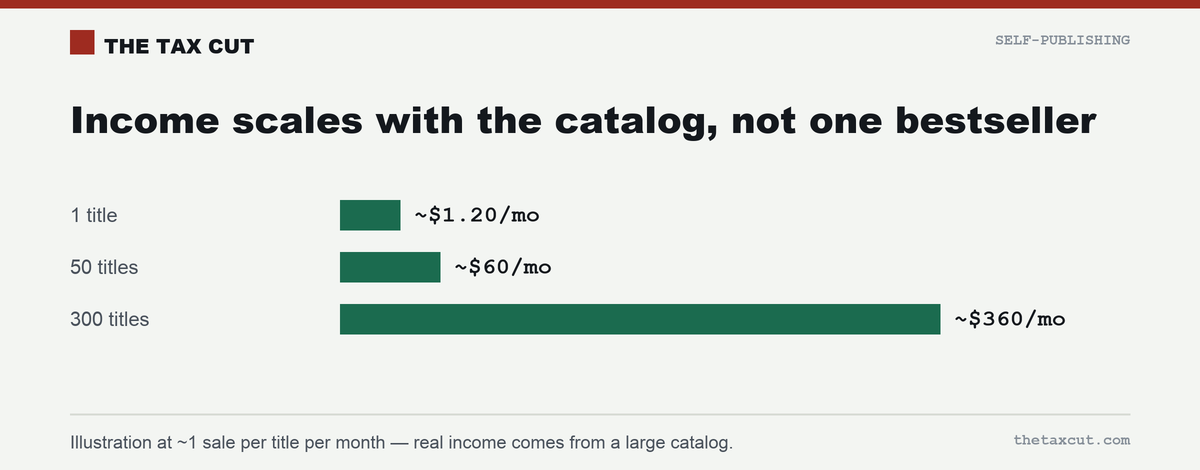
This is the part that kills the “passive” fantasy: to earn real money you need many well-researched titles, each selling a little — not one book selling a lot. That’s a production operation, not a weekend upload.
What actually changed in 2026: saturation and AI
The market matured, hard:
- Saturation. The coloring-book and journal niches were flooded with thousands of near-identical, AI-generated titles across 2023–2024. Competing for the same keywords now takes genuine design and research, not a template.
- Stricter policing. Amazon increased scrutiny of low-content submissions, removing books deemed low-quality or duplicative — and hitting repeat offenders with account-wide publishing restrictions.
- AI disclosure is now normal. Over 30% of new 2026 titles carry some AI disclosure. KDP allows AI assistance but treats unedited, low-quality AI output as a liability — use it as a tool, not the whole product.
Source: Amazon KDP — Content guidelines (AI-generated content) · checked 2026-07-29
The barrier to entry fell (AI makes interiors fast); the barrier to earning rose (quality and differentiation now decide who ranks).
So — are low-content books worth it in 2026?
Worth it if:
- You treat it as a business: keyword research, real design, and a growing catalog of dozens to hundreds of titles.
- You use AI as an assistant and add genuine quality on top, staying inside KDP’s rules.
- You’re patient — royalties build slowly as the catalog and reviews grow.
Not worth it if:
- You want passive income from a handful of template journals — that market is saturated and policed.
- You plan to mass-upload undisclosed AI content — that’s the fast path to account restrictions.
Low-content publishing in 2026 is smaller, more demanding, and more rewarding for the disciplined than it was in 2020. The $1.20-a-book math means the money was always in the catalog, not the shortcut. For the full royalty and printing breakdown, see what a KDP book really makes per month.
People also ask
Are low-content books still profitable in 2026?
Yes, but only at volume and quality. At ~$1.20 a book, income comes from a large, well-researched catalog — not one title. The template-journal shortcut is saturated and more strictly policed.
Source: Amazon KDP — Royalty rates · checked 2026-07-29
Is the low-content book market saturated?
Heavily, in the popular niches — coloring books and journals were AI-flooded in 2023–2024. Ranking now requires real design and keyword research, not a duplicate template.
Can you use AI to make low-content books?
Amazon allows AI assistance and asks you to disclose AI-generated content, but low-quality, undisclosed AI output can trigger removals and account-wide restrictions. Use it as a tool, not the sole creator.
How much does a low-content book make?
About $1.20 per $6.99 paperback after Amazon’s 50% and printing — so a single title earns little; a catalog of many titles is where the income is.
See it for your own numbers
Every calculator shows revenue. This one shows what lands.
Related on The Tax Cut
- What does a KDP book really make per month? — the parent breakdown: royalty, printing, and portfolio math.
- Is affiliate marketing dead in 2026? — another online income reshaped by saturation and AI.
- How much do sneaker resellers actually profit? — thin per-unit margins that only work at volume.