Instacart looks like the friendliest of the delivery gigs: you shop for groceries instead of racing food across town, and the app quotes a decent hourly. Like every gig where you supply the car, though, the quoted number and the banked number are different — and Instacart has one twist that changes the whole strategy: the batch base pay is low, so tips are the paycheck. Here’s what Instacart shoppers really make.
Gross vs. net: the car takes its cut
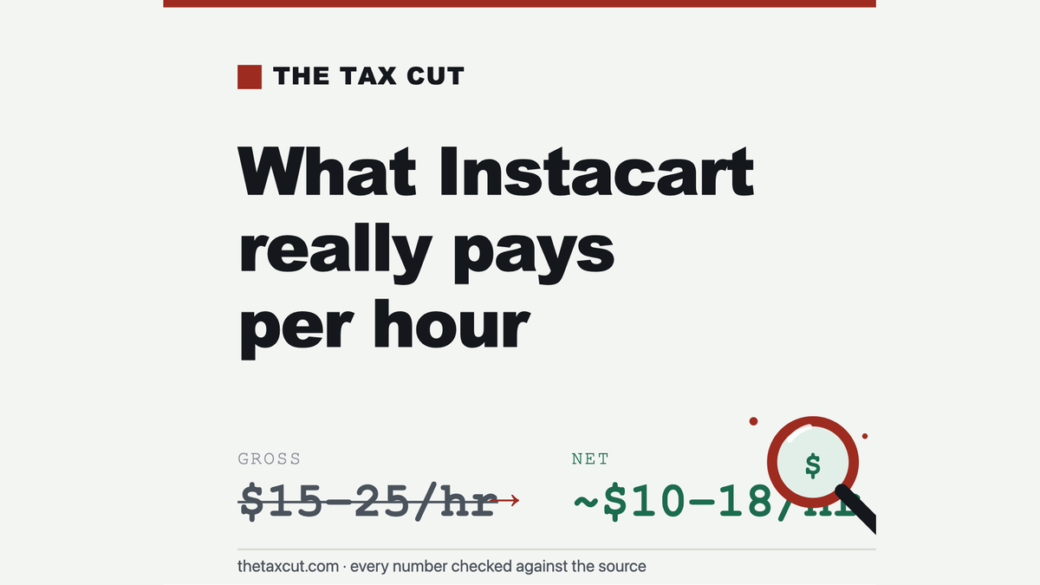
Instacart shoppers gross $15–$25 an hour in 2026. Then the same costs that hit DoorDash and Uber drivers apply — because you’re driving your own car for it.
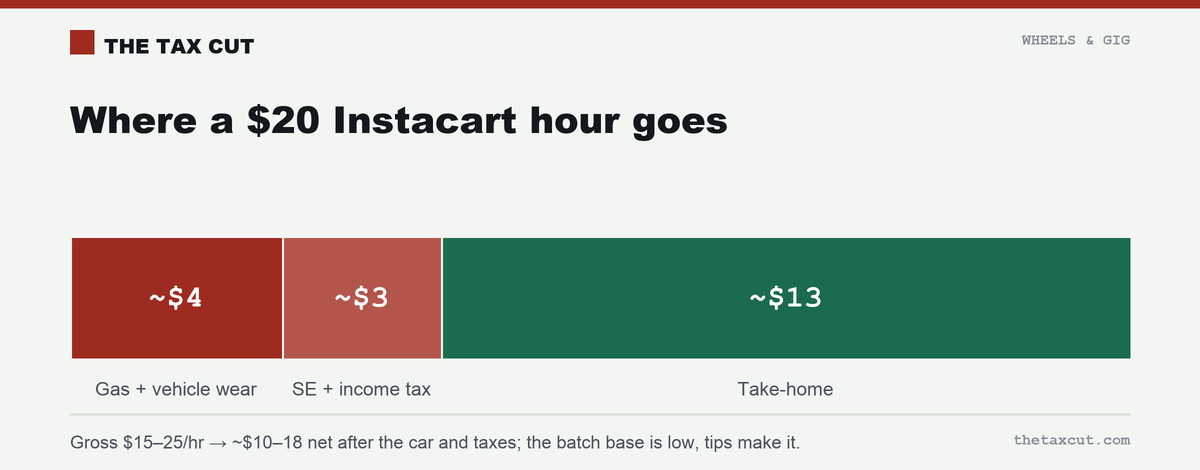
After gas, vehicle wear, and self-employment tax, the real rate lands at $10–$18/hour. The pay is built from a low batch base ($7–$15 per order), customer tips ($5–$15+), heavy-order pay, and mileage ($0.60/mile) — and it’s the tips, not the base, that make the hour worth doing.
Source: SideQuestHustle — Instacart shopper pay after expenses (2026) · checked 2026-07-29
The twist: tips are 50–70% of the pay
Here’s what makes Instacart different from other gigs. The batch base is deliberately low; tips make up 50–70% of a top shopper’s total earnings. That single fact flips the strategy: your income depends far more on which market you work than on how many hours you put in.
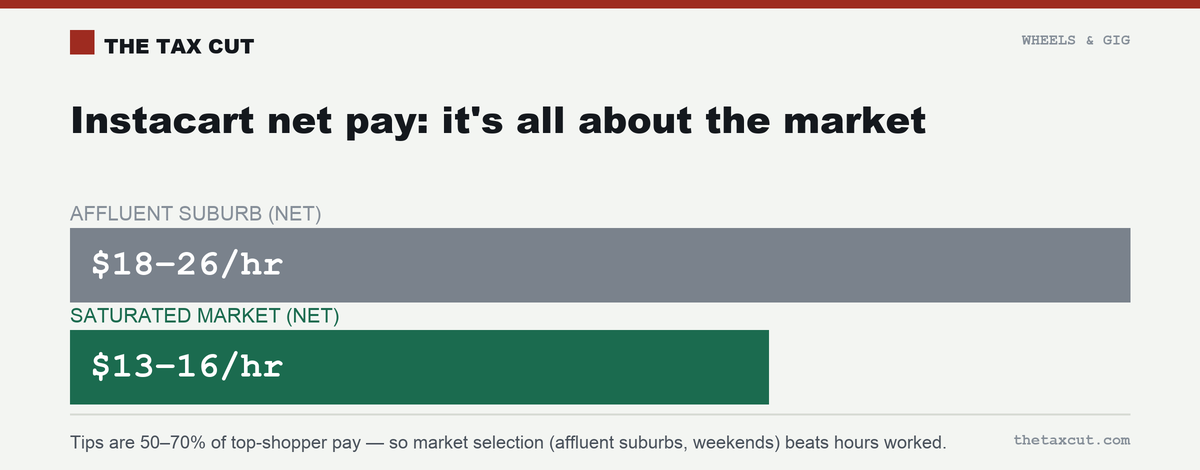
Work affluent suburbs on Friday–Sunday windows and you net $18–$26/hour; grind a saturated, lower-tip market and it’s $13–$16 for the same effort. Experienced shoppers treat it as a tip-maximization game — choosing high-tip areas and times, taking larger orders, and giving great service to earn repeat customers — rather than an order-count grind. A well-chosen 15–20 hour weekend can net $400–$800 after expenses.
Source: ShiftTracker — Is Instacart worth it in 2026? (net pay after expenses) · checked 2026-07-29
The costs and caveats the app skips
- Your car. Gas, tires, and depreciation come out of the pay — track your miles for the tax deduction ($0.725/mile IRS rate offsets most taxable income).
- Tips can be adjusted. Instacart tips can change after delivery, so a promised big tip isn’t guaranteed until it settles.
- No guaranteed volume. Batches ebb and flow; slow windows pay nothing while you wait.
- Self-employment tax. The net figure is before setting aside for 15.3% self-employment tax plus income tax.
So how much do Instacart shoppers really make?
- Gross: $15–$25/hour; net $10–$18 after gas, wear, and tax.
- Tips are 50–70% of pay — market selection beats hours worked.
- Affluent suburbs, weekends: $18–$26/hour net; saturated markets: $13–$16.
- It’s a tip-maximization game, not an order-count grind — and the car takes its cut either way.
Instacart is legitimate, flexible income, and in the right market it can out-earn food delivery per hour — because groceries mean bigger orders and bigger tips. But budget off the ~$10–$18 net, choose high-tip areas and times deliberately, and track your mileage. Play it as a tip game in an affluent market, and it pays well; treat it as clocking hours anywhere, and the car quietly eats the difference.
People also ask
How much do Instacart shoppers make per hour after expenses?
Gross is $15–$25/hour, but after gas, vehicle wear, and self-employment tax the real rate is $10–$18/hour — $18–$26 in affluent suburbs, $13–$16 in saturated markets.
Source: SideQuestHustle — Instacart shopper pay · checked 2026-07-29
Are tips a big part of Instacart pay?
Yes — tips make up 50–70% of a top shopper’s earnings. The batch base pay ($7–$15/order) is low, so market and time selection (high-tip areas, weekends) matters more than hours worked.
Is Instacart worth it in 2026?
It’s worth it in affluent suburbs on weekend windows, treated as a tip-maximization game — experienced shoppers there net $18–$26/hour. In saturated, low-tip markets it drops to $13–$16 after expenses.
Does Instacart pay for gas?
No. You cover gas, maintenance, and wear on your own car. Track your miles — the $0.725/mile IRS deduction offsets most of your taxable Instacart income.
See it for your own numbers
Every calculator shows revenue. This one shows what lands.
Related on The Tax Cut
- What does DoorDash really pay per hour? — the food-delivery version of the same gross-vs-net gap.
- What do Uber & Lyft drivers really make? — rideshare, with the same car-cost math.
- What does Amazon Flex pay after gas and mileage? — block pay minus the miles.