
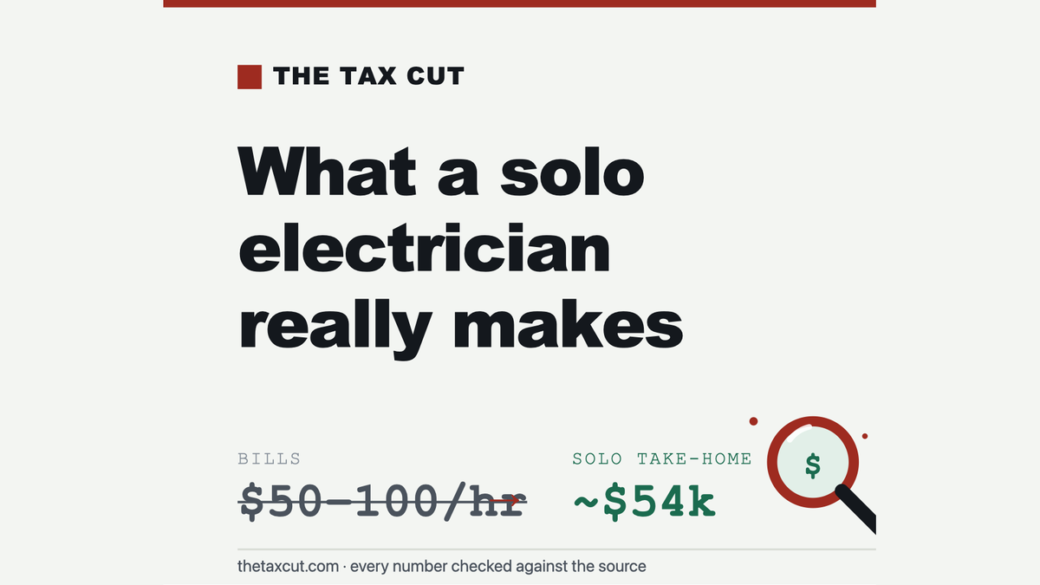
An electrician quotes $90 an hour and the homeowner assumes the electrician is banking $90 an hour. The electrician knows the truth: after the van, the insurance, the licensing, the unbillable drive, and the warranty callback on last month’s job, that $90 rate turns into something closer to $26 in actual take-home. The gap isn’t profit — it’s the cost of running a legitimate trade business. Here’s what a self-employed electrician really makes.
The billable rate vs. the take-home
Self-employed electricians bill customers $50–$100/hour (often more with service fees layered on top). But that’s the billing rate, not the earning rate.
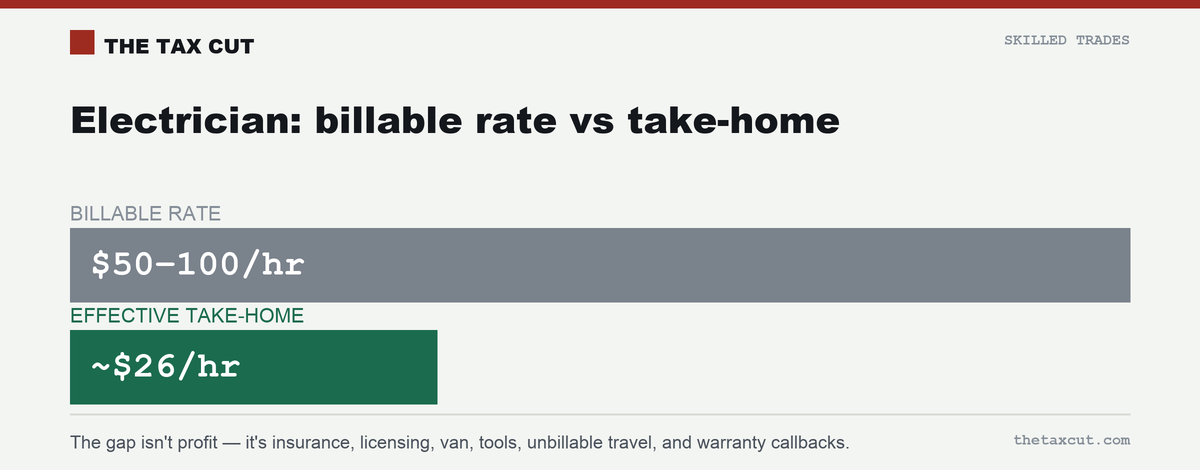
The average self-employed electrician earns about $54,640 a year — roughly $26/hour in real take-home. The difference between the $90 you bill and the $26 you keep is not margin — it covers insurance, licensing fees, vehicle costs, tools, call-answering time, unbillable travel, warranty callbacks, and the overhead of a real business. Every trade has this gap; electricians who don’t account for it end up “charging $90” and wondering where the money went.
Source: ZipRecruiter — Self-employed electrician salary (2026) · checked 2026-07-29
The levers: master license and a business
The solo ~$54k isn’t the ceiling — it’s the starting point. Two things move the number up.
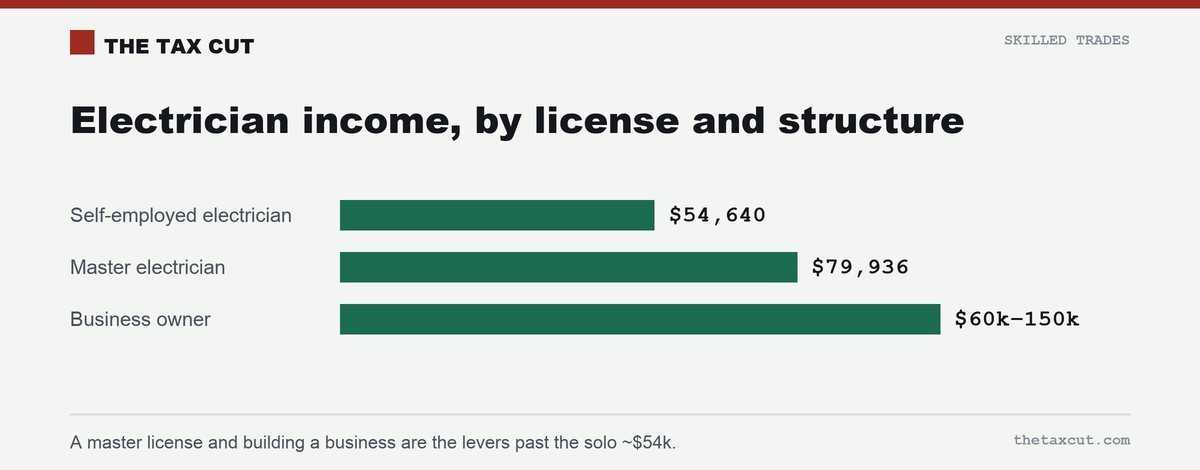
A master electrician license lifts the average to about $79,936, because it unlocks higher-value work, permits, and the ability to pull your own jobs. And building an electrical business — hiring, taking bigger contracts — pushes owner income to $60,000–$150,000+. Most small-business owners take 30–50% of net profit as salary and reinvest the rest. The trade rewards credentials and scale, not just swinging a screwdriver faster.
Source: Jobber — How much do electricians make (2026) · checked 2026-07-29
The pricing discipline that protects the income
Like plumbers and handymen, electricians live or die on billing discipline:
- Price the whole job, not the wire time. Drive time, quoting, permits, and callbacks are real hours — build them in or use a service-call minimum.
- Know your break-even rate so you never bill below what covers overhead plus a living wage.
- Charge for expertise, not just labor — troubleshooting, code compliance, and safety are what customers actually pay a licensed pro for.
- Set aside ~30% for tax — self-employment tax plus income tax on net profit.
So how much do self-employed electricians really make?
- Billing rate: $50–$100/hour+ — but that’s not take-home.
- Solo take-home: ~$54,640/year (~$26/hour effective); the gap is overhead, not profit.
- Master electrician: ~$79,936; business owner: $60,000–$150,000+.
- The levers are credentials (master license) and scale (a real business).
Electrical work is a genuinely solid trade — but the honest number is the take-home, not the billing rate. Solo, that’s about $54,000, because a huge slice of what you charge goes to running the business, not to you. Get your master license, price the whole job (not just the time with tools in hand), and build toward a business, and the trade pays a real upper-middle income. Confuse the billing rate with the paycheck, and you’ll work like you make $90 an hour while living like you make $26.
People also ask
How much do self-employed electricians make?
The average is about $54,640 a year (~$26/hour take-home), even though they bill customers $50–$100/hour — because the gap covers insurance, licensing, vehicle, tools, and unbillable time. Master electricians average ~$79,936; business owners $60,000–$150,000+.
Source: ZipRecruiter — Self-employed electrician salary · checked 2026-07-29
Why don’t electricians keep their full hourly rate?
Because the gap between the $50–$100/hour billing rate and take-home isn’t profit — it covers insurance, licensing fees, vehicle and tools, call-answering, unbillable travel, and warranty callbacks.
How much does a master electrician make?
About $79,936 a year self-employed — higher than a regular self-employed electrician (~$54,640) because the license unlocks higher-value work, permits, and the ability to pull your own jobs.
How do electricians make more money?
Get a master license (~$80k average), price the whole job (not just wire time), charge for expertise and code compliance, and build a business with employees to pass the solo billable-hours ceiling ($60k–$150k+ owner income).
See it for your own numbers
Every calculator shows revenue. This one shows what lands.
Related on The Tax Cut
- Self-employed plumber income — the same billing-vs-take-home gap in a sister trade.
- How much does a handyman make? — the billable-hours and overhead trap at a lower skill level.
- Underwater welder salary — a trade where the premium is risk, not overhead.