
The short answer is yes — if you resell sneakers for profit, that profit is taxable, and “I never got a tax form” is not the loophole people think it is. The rules changed again for 2026, and the gap between when a form shows up and when tax is owed is exactly where resellers get caught. Here’s how it actually works.
The 1099-K threshold vs. what’s actually taxable
For 2025 and 2026, the 1099-K reporting threshold is back to $20,000 in payments and at least 200 transactions, after the One Big Beautiful Bill (July 2025) scrapped the planned $600 and $2,500 thresholds. So StockX, GOAT, eBay, or PayPal generally won’t send you a form until you cross that line.
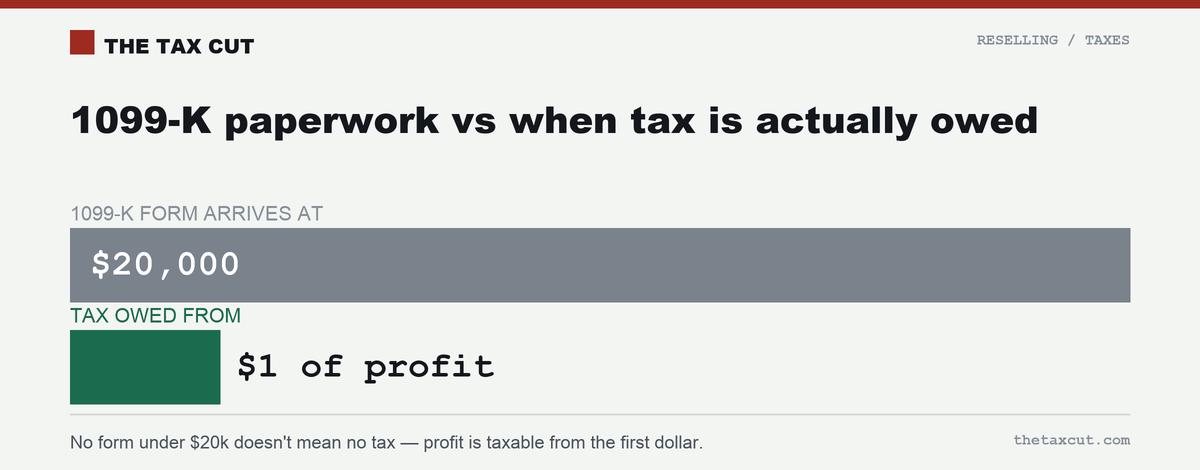
Here’s the trap: the form is just paperwork; the tax is owed regardless. The IRS is explicit that you must report every dollar of profit, whether or not a 1099-K is issued. No form under $20,000 doesn’t mean no tax — it means you’re responsible for tracking and reporting it.
Source: TaxAct — 2026 Form 1099-K reporting thresholds (OBBBA) · checked 2026-07-29
You’re taxed on profit, not the sale price
The good news that surprises new resellers: you’re not taxed on the $220 a pair sold for — you’re taxed on the profit after your costs.
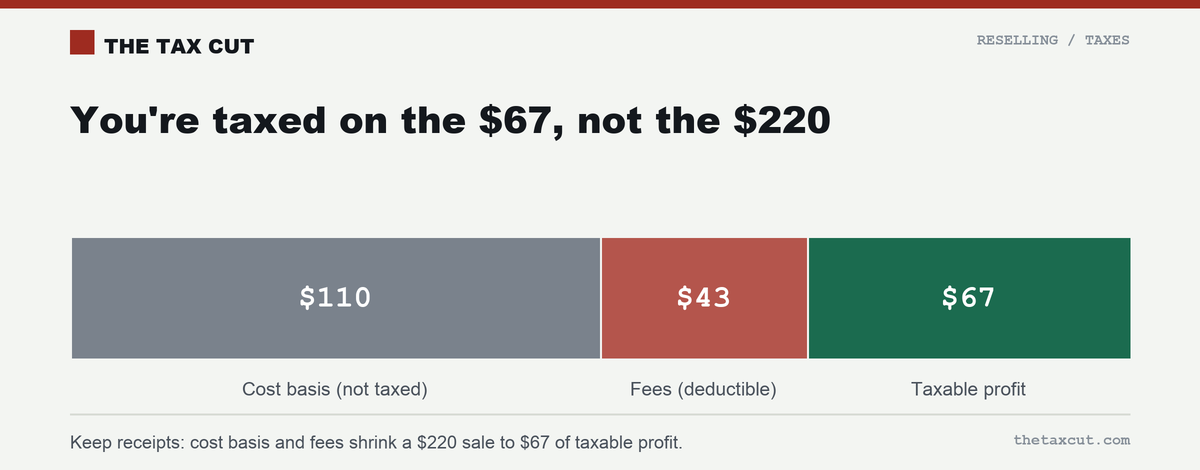
Take a pair bought for $110 and sold for $220. Your cost basis ($110) and your selling costs (StockX/GOAT fees, shipping — about $43) come off first. Only the $67 profit is taxable. Keep receipts: your cost basis and fees are what shrink a $220 “sale” down to a $67 taxable number. Lose the receipts and you risk being taxed as if the whole $220 were profit. (Where that $43 in fees comes from: how much sneaker resellers actually profit.)
Hobby vs. business — the split that sets your tax
How you’re taxed depends on whether the IRS sees a hobby or a business:
- Occasional flips (hobby): you still report the profit, but you generally can’t deduct expenses beyond cost basis, and you don’t pay self-employment tax.
- Consistent, profit-seeking reselling (business): you report on Schedule C, deduct your fees, shipping, mileage, and supplies — but you also owe self-employment tax (15.3%) on the net profit, on top of income tax.
Most people who “flip sneakers” regularly, sourcing to resell, are running a business in the IRS’s eyes. That’s not bad news — it unlocks deductions — but it does mean self-employment tax on the profit.
So, what should a reseller actually do?
- Track every pair: buy price, sell price, platform fees, shipping. That record is what proves your profit is $67, not $220.
- Set aside ~25–30% of profit for taxes if you’re operating as a business (income + self-employment tax combined, roughly).
- Don’t wait for a form. Report profit whether or not a 1099-K arrives; platforms may also issue one voluntarily below the threshold.
- Separate hobby from business honestly — frequency and intent to profit decide it, not your preference.
Reselling sneakers is a legitimate, taxable business. The tax isn’t triggered by a form landing in your inbox; it’s triggered by the profit, from the first pair. For where that profit actually comes from after fees, see how much sneaker resellers actually profit.
People also ask
Do I have to pay taxes on reselling sneakers if I don’t get a 1099-K?
Yes. In 2026 the 1099-K only arrives at $20,000 and 200 sales, but tax is owed on your profit from the first dollar regardless of whether a form is issued.
Source: TaxAct — 1099-K thresholds · checked 2026-07-29
What is the 1099-K threshold for 2026?
$20,000 in payments and 200 transactions, after the One Big Beautiful Bill restored the old threshold for 2025 and 2026.
Are sneaker resellers taxed on the sale price or the profit?
On the profit. Your cost basis (what you paid) and selling costs (fees, shipping) come off first — only the net gain is taxable, which is why receipts matter.
Is reselling sneakers a hobby or a business for taxes?
Occasional flips are usually a hobby; consistent, profit-seeking reselling is a business reported on Schedule C — which allows deductions but adds 15.3% self-employment tax on net profit.
See it for your own numbers
Every calculator shows revenue. This one shows what lands.
Related on The Tax Cut
- How much do sneaker resellers actually profit? — the parent breakdown: fees, cost of goods, and the real margin.
- How much is 100 subs on Twitch? — the same 15.3% self-employment tax, on creator income.
- What does a KDP book really make per month? — another self-employment side income and its real numbers.