Paid medical studies show up on every “make money with your body” list, and the top ones pay far more than plasma or focus groups — a single Phase 1 trial can pay five figures. But the compensation reflects exactly what it asks: days confined in a research unit, taking a drug being tested in humans for the first time. This is an informational breakdown, not medical advice — joining a trial is a health decision. Here’s what clinical trials really pay, and the trade-off behind the number.
The pay scales with the commitment
Compensation ranges enormously by study type, and the highest-paying ones ask the most.
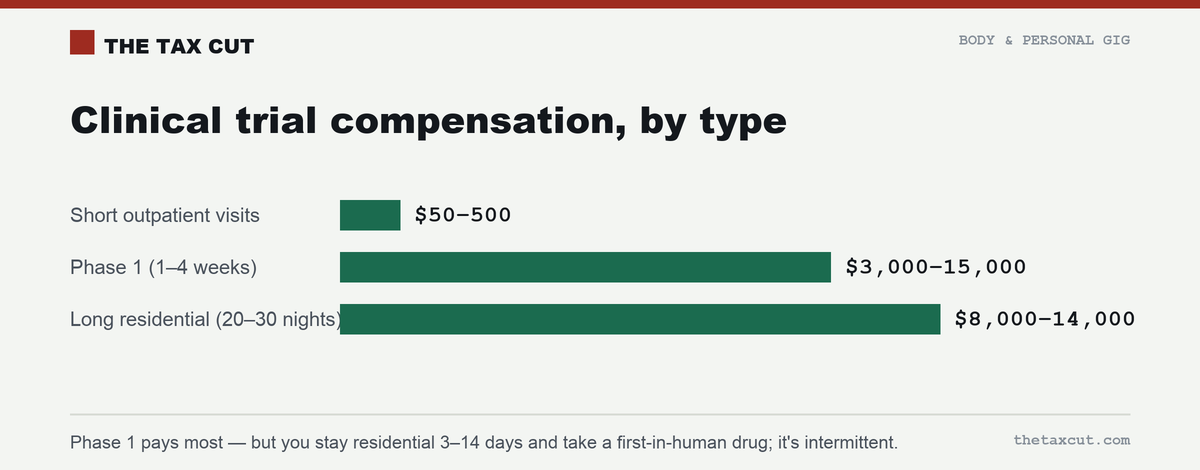
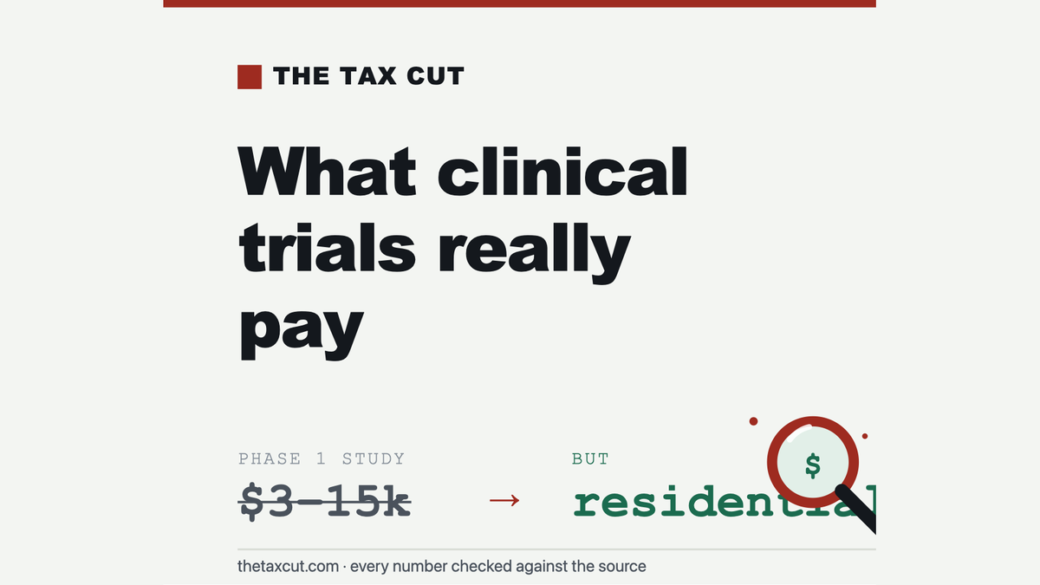
Short outpatient studies (a few visits, blood draws, surveys) pay $50–$500. Phase 1 drug trials — the highest-paying category — pay $3,000–$15,000 for a study lasting one to four weeks. Long residential stays of 20–30 nights can reach $8,000–$14,000 in aggregate. Phase 1 pays the most because it asks the most: first-in-human testing to find safe dosing.
Source: Focus Group Placement — Paid clinical trials for healthy volunteers (2026) · checked 2026-07-29
What a Phase 1 study actually involves
The daily rate looks good — until you understand what the “days” are.
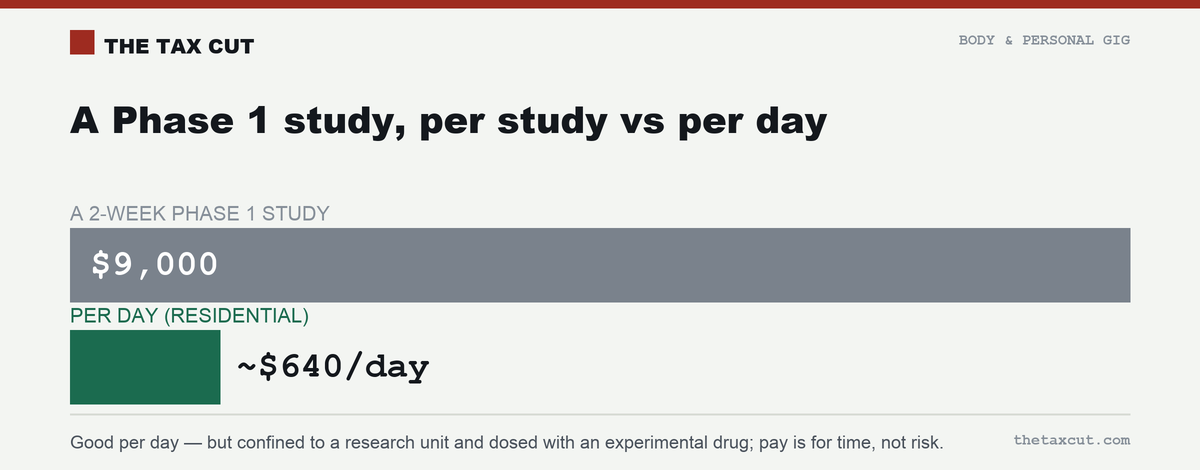
A Phase 1 study requires staying at a clinical research unit for 3–14 days (sometimes longer), receiving the drug, and undergoing intensive, continuous monitoring. A ~$9,000 two-week study works out to about $640 a day — genuinely high for the time — but those are days confined to a facility, being dosed with a compound whose effects in humans aren’t yet fully known. You’re not being paid a wage; you’re being reimbursed for time and inconvenience.
Ethically, that’s deliberate: compensation is meant to cover time and inconvenience, not to purchase risk. Institutional Review Boards (IRBs) specifically ensure payment isn’t so large that it “unduly influences” someone to join against their better judgment.
Source: ClinicalMetric — Clinical trial compensation (2026) · checked 2026-07-29
The reasons it isn’t steady income
- It’s intermittent. You can’t chain Phase 1 studies back-to-back — there are washout periods between drug exposures, so this is occasional income, not a monthly paycheck.
- Eligibility is strict. Screening covers health, age, BMI, medications, and history; many applicants are excluded, and each study has its own criteria.
- There’s real, if managed, risk. First-in-human dosing carries genuine uncertainty, which is precisely why the monitoring is intensive and the pay is high.
- It’s taxable income. Trial compensation is generally reportable.
So how much do clinical trials really pay?
- Short outpatient studies: $50–$500.
- Phase 1 drug trials: $3,000–$15,000 for 1–4 weeks (the highest-paying).
- Long residential stays: up to ~$8,000–$14,000.
- The trade-off: residential confinement, a first-in-human drug, strict eligibility, and intermittent timing — the pay is for time and inconvenience, not risk.
Clinical trials are legitimate and, for eligible healthy volunteers, among the best-paying items on any personal-income list. But the highest pay comes attached to the biggest commitment — days in a unit, an experimental drug, real (if carefully managed) risk. Treat it as a health decision to make with full information about the specific study, not a side hustle. The $640-a-day is real; so is everything that number is compensating for.
People also ask
How much do clinical trials pay in 2026?
Short outpatient studies pay $50–$500; Phase 1 drug trials pay $3,000–$15,000 for a 1–4 week study; and long residential stays (20–30 nights) can reach $8,000–$14,000.
Source: Focus Group Placement — Clinical trial pay · checked 2026-07-29
Why do Phase 1 clinical trials pay so much?
Because they ask the most: residential stays of 3–14 days, first-in-human drug testing, and intensive monitoring. The pay reflects the time and inconvenience — ethically, it’s not meant to compensate for risk.
Can you make a living doing clinical trials?
No — it’s intermittent income. Washout periods between drug exposures prevent back-to-back Phase 1 studies, and strict, study-specific eligibility screens out many applicants.
Is it safe to participate in a clinical trial?
Trials are heavily regulated with continuous monitoring and IRB oversight, but Phase 1 first-in-human testing carries genuine uncertainty. It’s a health decision to make with full information about the specific study.
See it for your own numbers
Every calculator shows revenue. This one shows what lands.
Related on The Tax Cut
- How much can you make donating plasma? — the frequent, lower-pay end of the body-gig spectrum.
- How much does egg donation pay? — another high-pay, medical-commitment gig.
- How much do surrogates get paid? — the highest-paying, longest-commitment option.