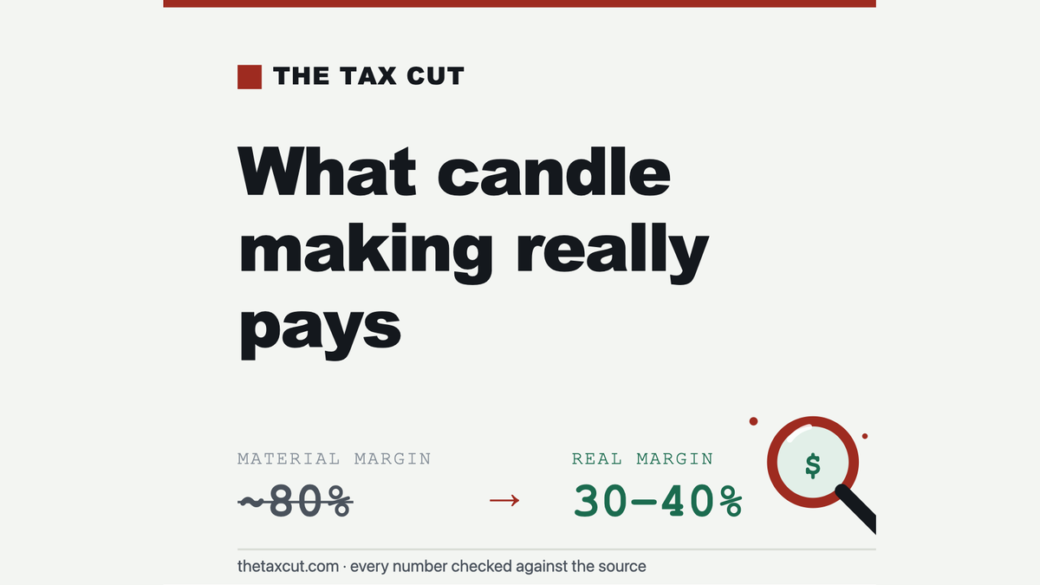
Candle making is the quintessential craft side hustle: cheap wax, a fragrance you love, and a $20 price tag on something that cost a few dollars to pour. That material margin is real and it’s gorgeous — around 80%. It’s also a trap, because it ignores the single biggest cost in any handmade business: your own time. Add that back, along with the marketplace’s cut, and the dreamy 80% becomes a 30–40% margin — and, for most sellers, a wage below minimum. Here’s the real math.
The material margin is a mirage
Start with why candle making looks so profitable. A typical 8oz soy candle costs about $3.40 in materials to make and sells for $20 — an ~80% gross margin on materials alone.
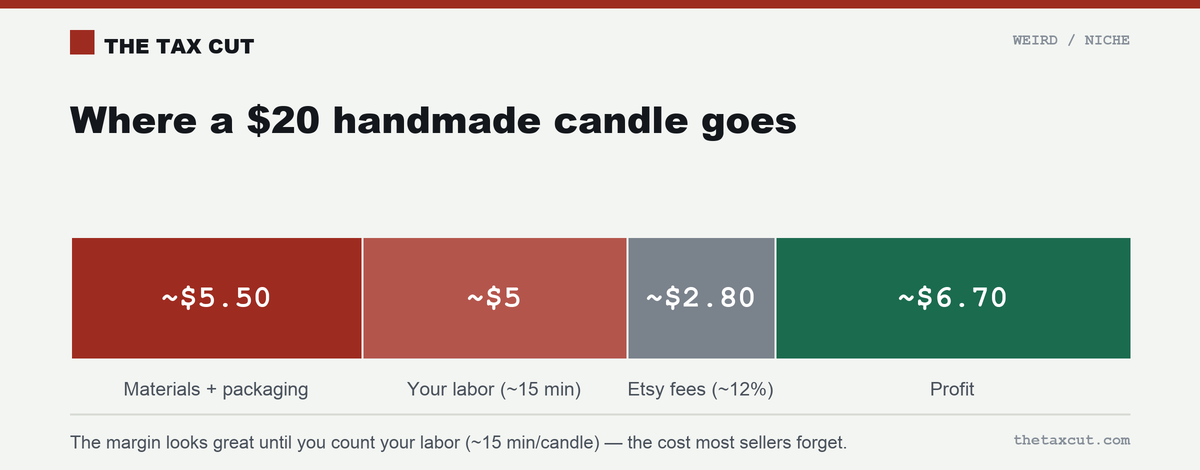
But materials aren’t the only cost. Add packaging (kraft box, tissue, label, thank-you card: $1.50–$2.50), your labor (~15 minutes a candle — $5 at $20/hour), and Etsy fees (10–12% of the sale). Now that $20 candle nets closer to $6.70 — real profit, but a fraction of the 80% the wax cost implied.
Source: Craftybase — Is candle making profitable? The real margins (2026) · checked 2026-07-29
The cost every candle maker forgets: their own time
Here’s the mistake that traps most handmade sellers: they don’t price their labor. Wick tabs, labels, containers, the tissue paper, and — crucially — the 12–15 minutes of actual work per candle get left out of the price. When you value that time at even $20/hour, it’s $5 of cost per candle that most sellers never charge for.
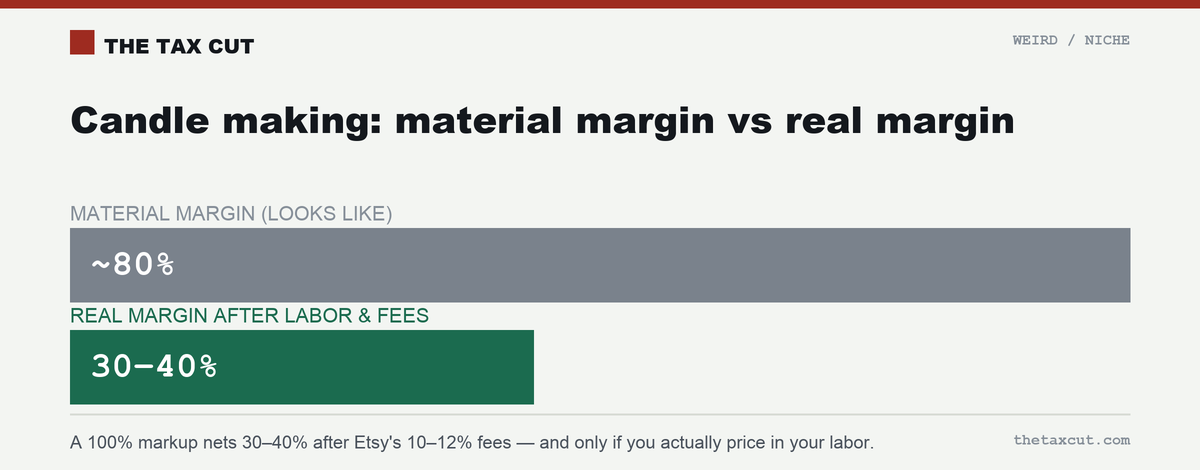
That’s why so many candle makers “profit” on paper while earning below minimum wage in practice — they’re subsidizing every sale with unpaid labor. The experienced sellers who actually make money target a 30–50% real profit margin after all costs, which usually means a 100% markup on fully-loaded production cost (materials + packaging + labor), and pricing that absorbs Etsy’s 10–12% fees.
Source: Craftybase — How to price candles (costing formula, 2026) · checked 2026-07-29
Why scaling doesn’t fix it
Candle making shares the trap of 3D printing and laser engraving: the per-unit labor doesn’t shrink. Every candle still has to be poured, cured, labeled, and packed by hand. Selling more candles means proportionally more hours — so without either raising prices or moving to wholesale batches, “more sales” just means “more unpaid labor.” The margin problem scales right along with the volume.
So is candle making profitable?
- Material margin: ~80% — and it’s a mirage.
- Real margin: 30–40% after packaging, labor, and Etsy’s 10–12% fees.
- The forgotten cost is your labor (~15 min/candle) — leave it out and you work below minimum wage.
- Per-unit labor doesn’t scale — more sales means more hours unless you raise prices or batch wholesale.
Candle making can be a real, profitable craft business — the demand for handmade candles is genuine and the margins can work. But only if you do the one thing most sellers skip: price your own time. Charge a 100% markup on the fully-loaded cost, absorb the marketplace fees, and treat labor as a real expense. Do that and you keep a healthy 30–40%. Ignore it, and the beautiful 80% wax margin quietly pays you less than a fast-food job.
People also ask
Is candle making profitable in 2026?
It can be — experienced sellers target 30–50% real margins after all costs. But the ~80% material margin is a mirage: once you add packaging, your labor (~15 min/candle), and Etsy’s 10–12% fees, the real margin is 30–40%.
Source: Craftybase — Candle business margins · checked 2026-07-29
How much profit is in a candle?
On a $20 candle costing ~$3.40 in materials, the material margin looks like 80% — but after ~$2 packaging, ~$5 labor, and ~$2.80 Etsy fees, the real profit is around $6.70 (30–40%).
Why do most candle makers lose money?
Because they don’t price their labor. Leaving out the 12–15 minutes of work per candle means the “profit” is really unpaid time — which is why many handmade sellers effectively earn below minimum wage.
How should I price handmade candles?
Use a fully-loaded cost (materials + packaging + labor) and apply roughly a 100% markup, so the price absorbs Etsy’s 10–12% fees and still leaves a 30–50% margin after your time is paid.
See it for your own numbers
Every calculator shows revenue. This one shows what lands.
Related on The Tax Cut
- 3D print farm profit — the same “per-unit labor doesn’t scale” trap.
- Laser engraving profit — a high material margin that shrinks once you price the time.
- eBay fees: what a $50 flip nets — how marketplace fees eat handmade and resale margins alike.