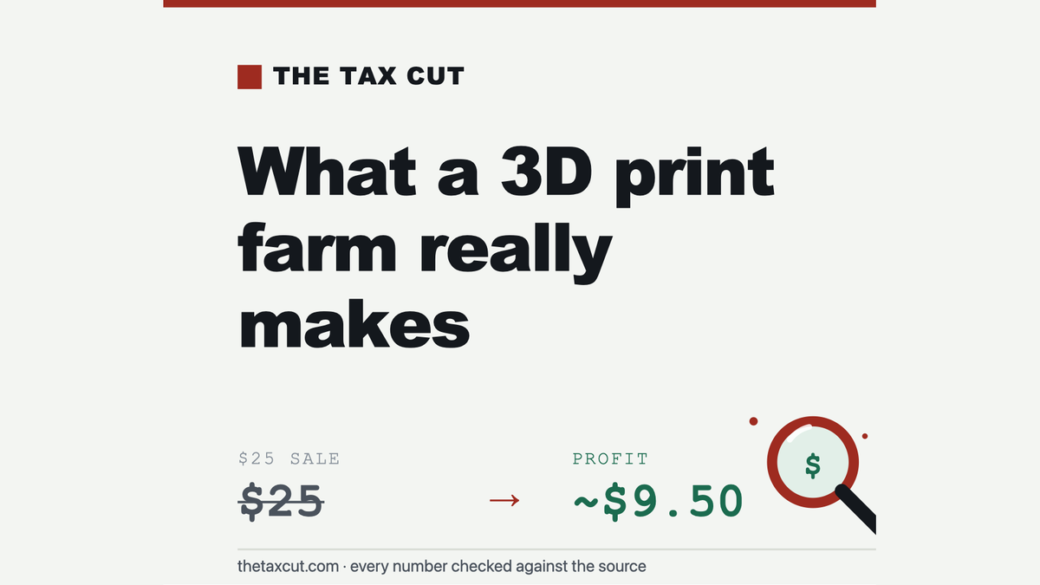
A wall of printers running 24/7, spitting out little products you sell while you sleep — the 3D print farm is sold as passive manufacturing. The filament math even backs it up: material margins of 30–70% look incredible. Then you actually run one, and discover the cost that no calculator shows and no printer can automate: the per-order human time. Here’s what a 3D print farm really makes.
The material margin really is high
Start with why the dream is seductive. The raw cost of a print — filament and electricity — is genuinely small against what you can charge.
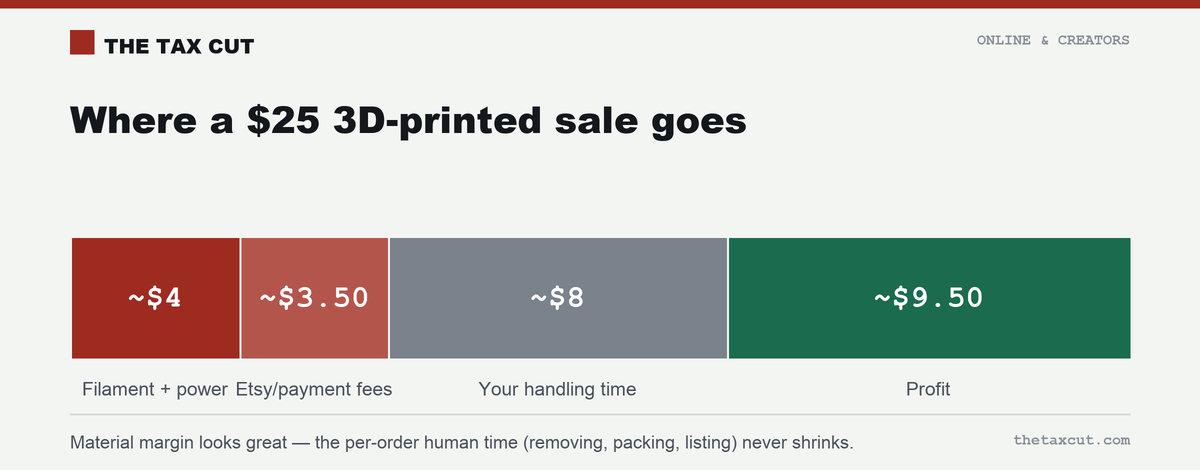
On a $25 item, maybe $4 goes to filament and electricity. If that were the whole cost, you’d keep $21. But it isn’t — marketplace and payment fees take ~$3.50, and the real killer is the handling time: removing the print, cleaning it, packing it, listing it, answering the buyer. Price that time honestly and the profit is closer to $9.50 — a fine margin, but not “passive.”
Source: SigmaFilament — Print farm income guide (2026) · checked 2026-07-29
The cost that never scales: your hands
Here’s the trap that sinks most print farms. Adding printers scales the printing. It does not scale the part where a human removes each print, packs each box, and handles each order. That per-order time stays stubbornly fixed no matter how many machines you own.
One widely-shared post-mortem says it best: an operator ran a print business for eight months, earned $3,666 in revenue, netted roughly 8%, and quit — concluding it was “a job, not a business,” because the human time per order never shrank. More printers just meant more boxes to pack.
Source: ShelfTrend — The brutal truth about where 3D-print profit hides · checked 2026-07-29
What a print farm realistically clears
Priced and run realistically — with a niche, correct pricing, and a real failure rate — the income is real but earned:
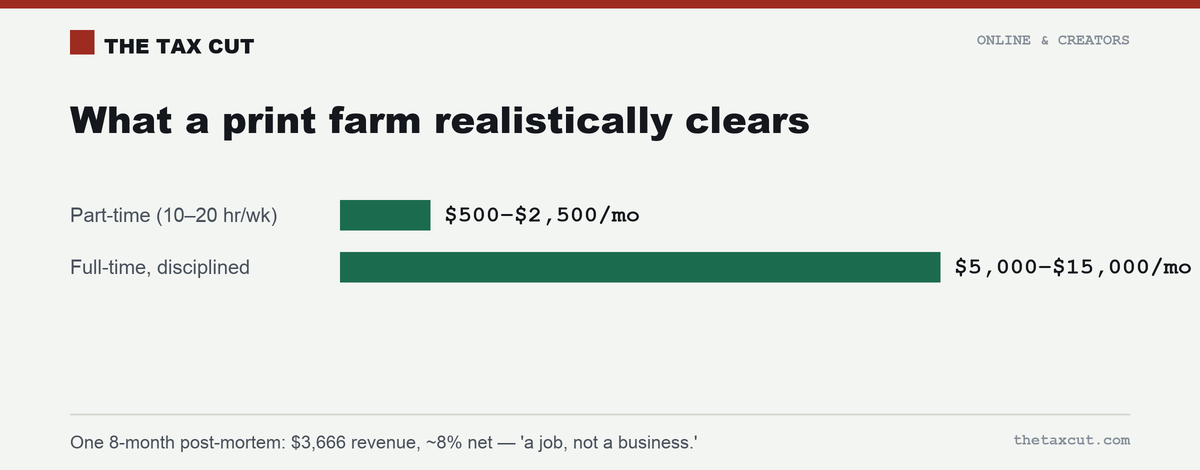
A part-timer putting in 10–20 hours a week can clear $500–$2,500/month in profit. A full-time farm with sales discipline can reach $5,000–$15,000/month. The gap between those numbers isn’t printer count — it’s whether you’ve niched down, priced in failures (a strict 5–10% of prints fail), and either sped up or outgrown the handling bottleneck.
Source: SigmaFilament — 7 steps to a profitable print farm · checked 2026-07-29
The costs the “passive” pitch skips
- Electricity. A bank of printers running 24/7 draws real power — a recurring cost, not a footnote.
- Failure rate. 5–10% of prints fail; that’s wasted filament, time, and sometimes a missed deadline.
- Marketplace fees. Etsy/Amazon fees compress the margin; DTC (your own Shopify) keeps more (25–40%) but you fund the traffic yourself.
- Design and support time. Sourcing or designing models, customer service, and reprints are unpaid unless you price them in.
So is a 3D print farm worth it?
- Per item: healthy margin (~$9.50 on a $25 sale) once fees and handling are honestly counted.
- Per month: $500–$2,500 part-time, $5k–$15k full-time — real, but hands-on.
- The bottleneck is human time, not printers — the winners kill handling time and price failures in.
- It’s a manufacturing job you run, not passive income — treat it like one and it pays.
A 3D print farm can absolutely make money — but the “printers make money while you sleep” pitch ignores the person packing boxes every morning. Price your time, niche down, and it’s a solid small business. Expect passive income and you’ll rediscover, at 8% margin, that it was a job all along.
People also ask
Is a 3D print farm profitable in 2026?
Yes, but it’s hands-on. Part-timers clear $500–$2,500/month and full-time farms $5,000–$15,000, once you price in fees, a 5–10% failure rate, and the per-order handling time that never scales.
Source: SigmaFilament — Print farm income · checked 2026-07-29
Why do 3D printing businesses fail?
Usually because the per-order human time (removing, cleaning, packing, listing, support) never shrinks with more printers. One operator netted ~8% over eight months and quit, calling it “a job, not a business.”
What are the real costs of a 3D print farm?
Filament and electricity (printers run 24/7), a 5–10% failure rate, marketplace/payment fees, machine depreciation, and — the big one — your own handling and design time.
How much can you make with a 3D printer?
On a $25 item, roughly $9–$10 profit after material, fees, and handling. Income scales with volume and pricing discipline, not just printer count.
See it for your own numbers
Every calculator shows revenue. This one shows what lands.
Related on The Tax Cut
- Are low-content books worth it in 2026? — another “passive” product business that’s really a volume grind.
- How much do sneaker resellers actually profit? — thin per-unit margins that only work at scale.
- eBay fees: what a $50 flip nets — the marketplace-fee side of selling physical goods.