Ask “how much do Rover sitters make” and the internet answers with a fee: Rover keeps 20%, you keep 80%. It’s true, it’s simple, and it’s the least important number in the whole equation. The 20% is the cut you can see. The cut that actually decides whether Rover is worth your time is invisible — it’s what happens when you divide your payout not by the number of nights, but by the number of hours a dog is living in your house.
So let’s do that division. Official fees first, then the effective pay nobody prints.
What Rover actually takes
Start with the part that’s clean and documented. Rover charges the sitter a 20% service fee, so you keep 80% of the rate you set. (Sitters who created a profile before March 2016 keep 85% — a grandfathered rate that no longer exists for new sitters.)
100% Your rate−20% Rover service fee80% You keep100% yours Tips
Source: Rover Help Center — What are the service fees? · checked 2026-07-28
Two more official facts change the picture. Pet owners pay their own fee on top — an 11% booking fee in most markets (a 25% marketplace fee in some pilot markets), which raises the total price the customer sees and quietly softens demand for your listing. And in California, sitters keep 75%, not 80%, under state marketplace rules.
Source: Rover Help Center — Fees and rates in California · checked 2026-07-28
Good news to bank before the bad: tips are 100% yours. Rover’s 20% never touches them.
The number nobody prints: pay per hour
Here’s where the official page stops. Boarding — the highest-earning Rover service — is priced per night, which hides what it really is: a 24-hour responsibility. Run the math on a normal week.
Board one dog at a $40/night rate for 7 nights:
$40/night Boarding rate$280 7 nights−$56 Rover 20%$224 You keep
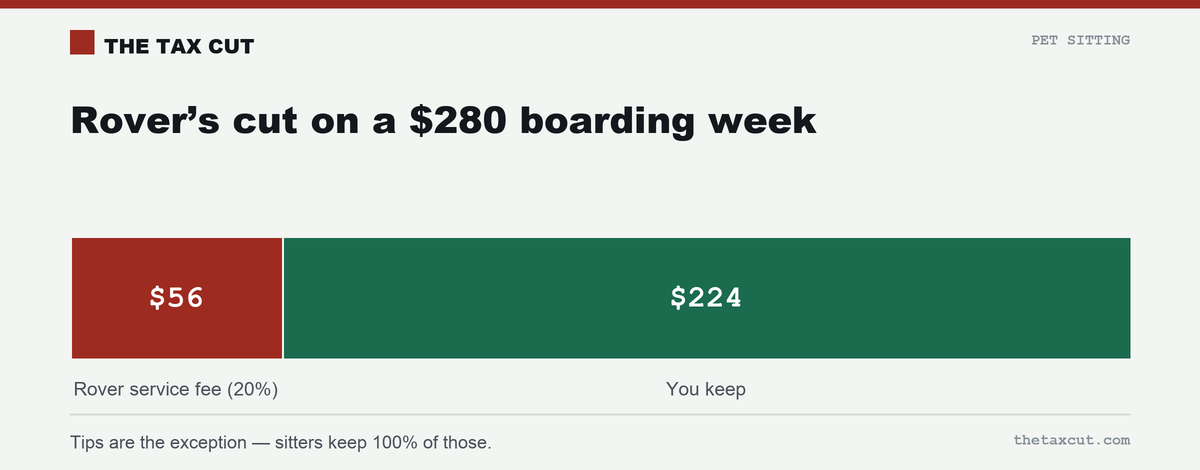
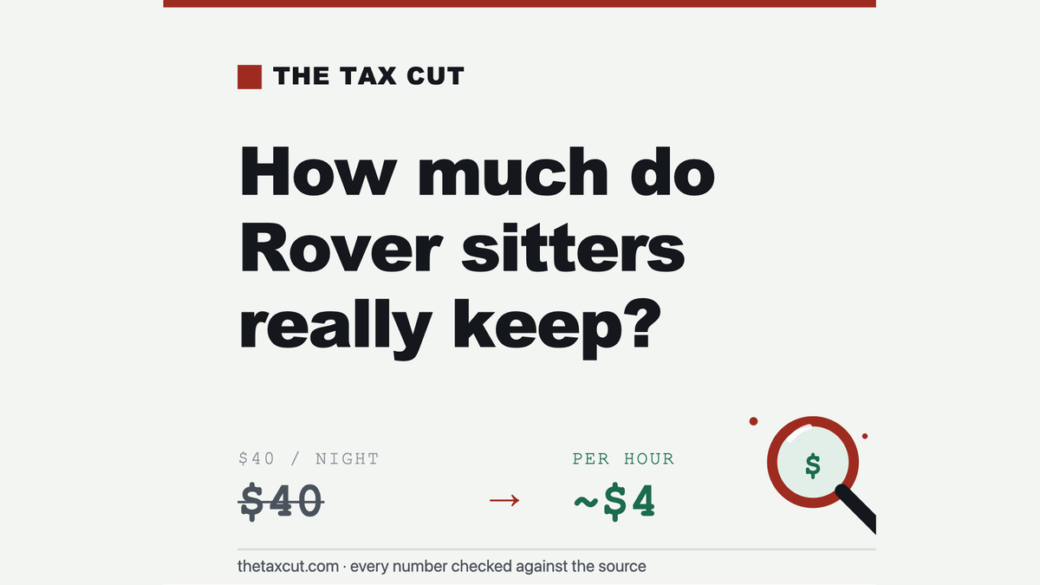
$224 for the week looks fine — until you notice the dog was in your home the entire time. Even if you generously count only 8 “on-duty” hours a night — feeding, walking, letting out, supervising — that’s 56 hours for $224, or about $4.00/hour. illustration; your rate and hours will differ Count the real 24-hour presence and it’s closer to $1.33/hour. Boarding pays a respectable nightly number and a minimum-wage-or-below hourly one, and the gap between those two is the entire honest answer to “is Rover worth it.”
The three unpaid costs that finish the job
Even $4/hour assumes the only unpaid thing is the fee. It isn’t.
1. The meet-and-greet. standard Rover practice Before most bookings, owners expect a free in-person meet-and-greet — often 30–60 minutes plus travel — to decide if they trust you. Do three of those to land one booking and you’ve worked two unpaid hours before a cent moves.
2. The slow start. This is the one that makes new sitters quit. Rover ranks established, well-reviewed sitters above you, so a brand-new profile can sit for weeks with zero bookings while it fights for its first review. The realistic answer to “how much does a new Rover sitter make” is frequently near $0 for the first month — not because the rate is bad, but because the visibility is.
Source: SideHustles — Rover sitter pay & fees review (2026) · checked 2026-07-28
3. Your home and your risk. Boarding means a stranger’s dog in your space — wear, accidents, your own pets displaced, and liability if something goes wrong. None of it is reimbursed, and all of it is real cost that the “80%” never mentions.
Claimed against banked
Put a realistic week together for a newer sitter: two boardings land, but each needed a meet-and-greet, and there’s cleanup between. illustration
$224 2 bookings kept~3 hrs Meet-and-greets (unpaid)~60 On-duty + turnover hrs≈$3.50/hr Effective rate
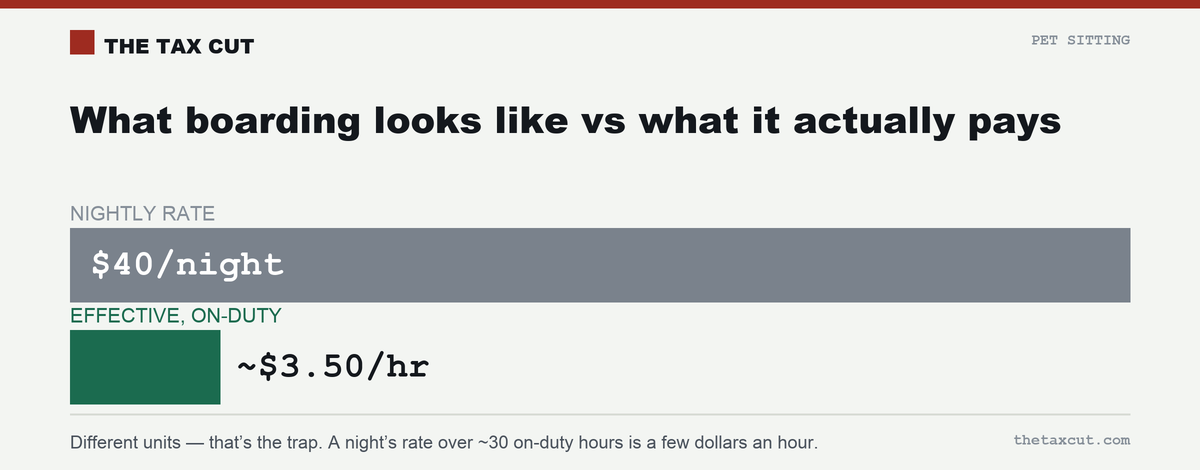
Nothing here is Rover cheating you. Every booking paid 80% exactly as stated. The distance between “$40 a night” and “$3.50 an hour” is built from the same materials as every gig on this channel: the hours that pay nothing, and a per-unit price that hides how many of those hours each unit costs.
So is Rover worth it for sitters?
It genuinely can be — for the right setup:
- You’re home anyway. If you’d be on your couch regardless, boarding a calm dog turns dead hours into $30–$50 a night. The low hourly only stings if that time had another use.
- You stack the high-value services. Boarding and daycare pay far more per booking than 30-minute walks, where the 20% cut and drive time eat the thin margin fastest.
- You survive the ramp. The sitters who make real money are the ones with 50+ reviews who rank at the top of their zip code. Getting there means months of underpaid, over-delivered bookings first.
- You count tips and repeat clients. Tips are 100% yours, and a handful of loyal owners who book you directly every month is what quietly turns Rover from a lottery into an income.
For a homebody with a fenced yard and patience for the slow start, Rover is a real side income — modest per hour, but paid for time you’d otherwise spend doing nothing. For someone expecting the nightly rate to be the paycheck, or needing money in the first few weeks, the honest answer is: not yet, and not that much. The 20% was never the number that mattered. The hours were.
People also ask
What percentage does Rover take from sitters?
A 20% service fee, so you keep 80%. In California it’s 75%, and profiles created before March 2016 keep 85%. Pet owners also pay their own booking fee on top, which raises the total price customers see.
Source: Rover Help Center — Service fees · checked 2026-07-28
Does Rover take a cut of tips?
No. Tips are 100% yours — the 20% service fee never touches them.
How much can a new Rover sitter make?
Often close to $0 in the first month. Rover ranks established, well-reviewed sitters above new profiles, so a beginner can sit for weeks with no bookings while fighting for a first review.
Is Rover boarding worth it?
If you’d be home anyway, yes — boarding a calm dog turns idle hours into $30–$50 a night. The low hourly only stings if that time had another use. Expecting the nightly rate to be your paycheck is where people get disappointed.
See it for your own numbers
Every calculator shows revenue. This one shows what lands.
Related on The Tax Cut
- How much does DataAnnotation actually pay? — measuring the effective rate the same way, hour by hour.
- Is Turo worth it in 2026? — the visible fee isn’t the real cut.
- What does an Airbnb host actually keep? — hospitality income after the platform and the cleaning.