Egg donation shows up on “make money with your body” lists next to plasma and feet pics, but it belongs in a different category entirely. The pay is genuinely high — far more per cycle than almost any gig on this site — but it’s a medical procedure, not a quick errand: hormone injections, a surgical retrieval, weeks of monitoring, and a hard lifetime limit. This is an informational breakdown, not medical advice — the decision is a personal and medical one. Here are the honest numbers and what they actually involve.
The compensation is real — and high
Egg donor pay is among the highest in the personal-gig world, and it scales with experience, traits, and cycle type.
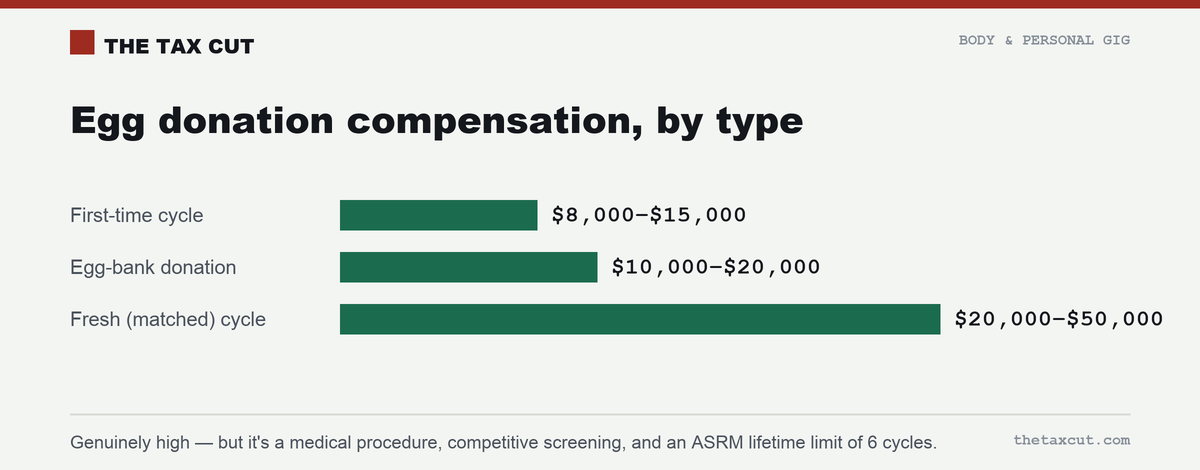
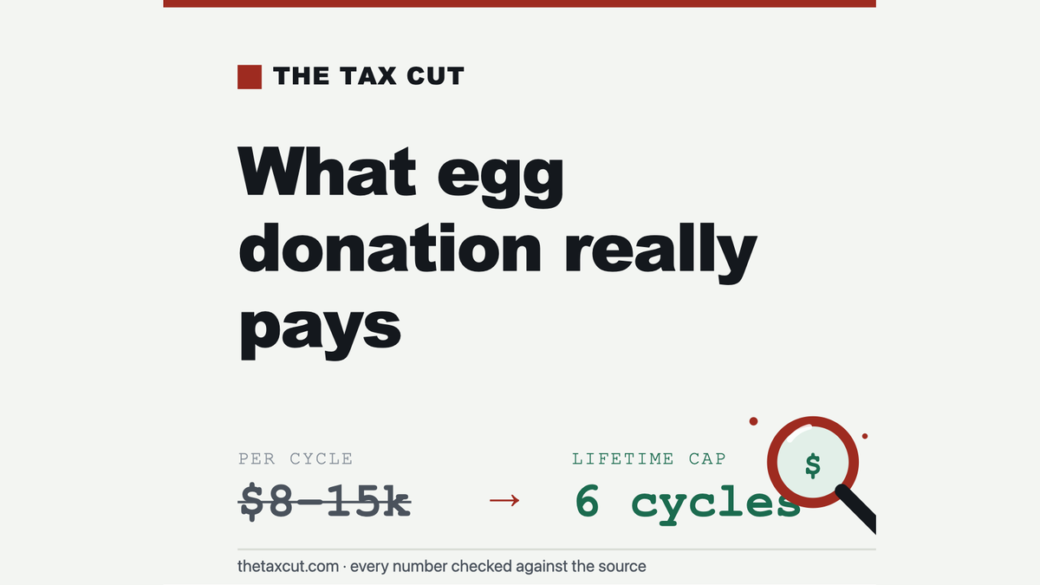
First-time donors in 2026 typically earn $8,000–$15,000 per cycle. Egg-bank donations average $10,000–$20,000, and fresh (matched) cycles can pay $20,000–$50,000 for donors with sought-after traits or a history of successful donations — with rare outliers from $5,000 to $100,000. That’s real money for a single cycle. The catch is everything the cycle involves.
Source: Lucina Egg Bank — What egg donors actually earn ($8k–$50k/cycle) · checked 2026-07-29
It’s a medical procedure with a hard lifetime cap
This is the part that separates egg donation from other “body gigs.” It’s a multi-week medical process, and you can only do it a limited number of times.
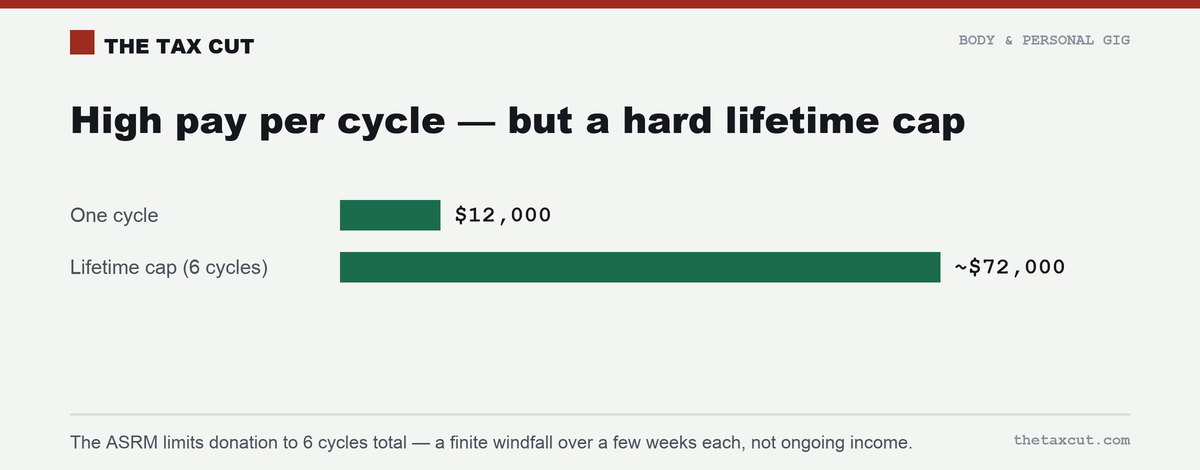
A cycle takes about four weeks, including roughly 7–10 clinic visits over two weeks for ultrasound monitoring and blood tests, injectable hormone medications to stimulate the ovaries, and a 15–20 minute retrieval under light anesthesia (most donors recover within a day). And there’s a firm ceiling: the ASRM recommends a maximum of six donations in your lifetime, across all clinics — partly to protect the donor, partly the potential offspring. So egg donation is a finite windfall, not repeatable income: even at the top of the range, six cycles is the whole story.
Source: Lucina Egg Bank — The 6-cycle lifetime limit (ASRM) · checked 2026-07-29
The considerations the pay glosses over
- Screening is competitive. A general interview, blood testing, and a psychological assessment mean not everyone qualifies — many applicants are screened out.
- Real medical risk, mostly low. Serious complications are rare (studies put the overall complication rate around 0.4%, serious complications ~1 in 1,000), but hormone medications commonly cause bloating, abdominal pain, and mood changes, with a risk of ovarian hyperstimulation syndrome (OHSS).
- Time and body cost. Weeks of appointments, self-administered injections, and a recovery — earned with your time and your body, not just an afternoon.
- It’s taxable income. Donor compensation is generally reported and taxable; plan for it.
Source: GoodRx — How much you get for donating eggs (process & risks) · checked 2026-07-29
So what does egg donation really pay?
- Per cycle: genuinely high — $8,000–$15,000 first-time, up to $20,000–$50,000 for matched fresh cycles.
- But it’s a medical procedure — hormone injections, 7–10 monitoring visits, a surgical retrieval, and a recovery.
- Capped at six lifetime cycles (ASRM) — a finite total, not ongoing income.
- Competitive screening, real (mostly low) medical risk, and taxable compensation.
Egg donation is one of the highest-paying things on any personal-gig list — and rightly so, because it’s a genuine medical commitment, not a side hustle. If you’re considering it, weigh it as a medical decision with a doctor, understand the six-cycle cap and the risks, and treat the pay as a meaningful but finite windfall. The $8,000–$15,000 is real; so is everything it asks of you.
People also ask
How much do you get paid for donating eggs?
First-time donors typically earn $8,000–$15,000 per cycle in 2026; egg-bank donations average $10,000–$20,000, and matched fresh cycles can reach $20,000–$50,000 for sought-after donors.
Source: Lucina Egg Bank — Egg donor pay · checked 2026-07-29
How many times can you donate eggs?
The ASRM recommends a maximum of six donations in your lifetime, across all clinics — so even at high per-cycle pay, it’s a finite total, not ongoing income.
What does egg donation actually involve?
A ~4-week cycle: 7–10 monitoring visits over two weeks, injectable hormone medications, and a 15–20 minute retrieval under light anesthesia, with most donors recovering within a day. Screening (interview, blood, psychological) comes first.
Is egg donation safe?
It’s considered low-risk — studies show an overall complication rate around 0.4% and serious complications near 1 in 1,000 — but hormone medications can cause bloating, pain, and mood changes, with a risk of ovarian hyperstimulation syndrome (OHSS). Discuss the risks with a doctor.
See it for your own numbers
Every calculator shows revenue. This one shows what lands.
Related on The Tax Cut
- How much can you make donating plasma? — the frequent-but-small counterpart to egg donation’s rare-but-large pay.
- Do you pay taxes reselling sneakers? — how side income like donor compensation is taxed.
- Is Rover worth it for sitters? — a very different flexible income, judged honestly.