BRRRR — Buy, Rehab, Rent, Refinance, Repeat — is real estate’s most seductive strategy: force appreciation with a renovation, refinance to pull all your cash back out, and roll it into the next deal, building a rental portfolio with the same money over and over. On paper it’s an infinite-money machine. In 2026, two things break the machine: 7%+ interest rates and renovation reality. Here’s what BRRRR really returns now.
The linchpin that no longer holds: the refinance
The entire strategy rests on one step — the Refinance — returning most or all of the cash you put in. With higher rates, it often doesn’t.
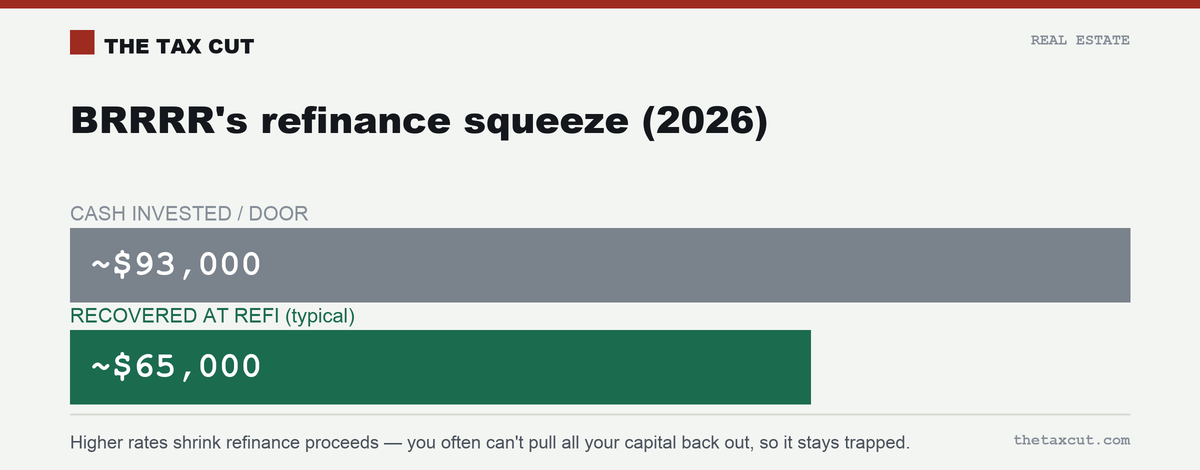
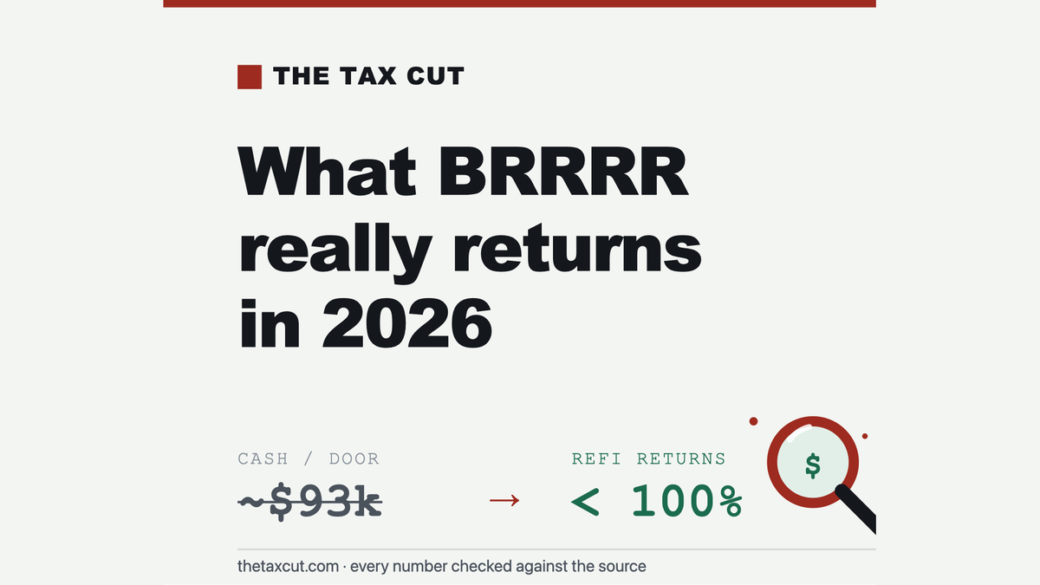
A typical door needs about $93,000 in cash (25% down on a ~$372,000 home, plus rehab). The plan is to refinance after forcing appreciation and pull that cash back out. But “higher-for-longer” rates above 7% shrink refinance proceeds and raise the DSCR (debt-service-coverage) hurdle lenders require. The result: you frequently can’t pull all your capital back out — a chunk stays trapped in the deal, so you can’t cleanly “repeat.” The infinite-money loop becomes a slow, capital-heavy grind.
Source: Moneywise — The BRRRR strategy in 2026 · checked 2026-07-29
The second break: renovation overruns
BRRRR margins are thin, and the rehab is where they die.
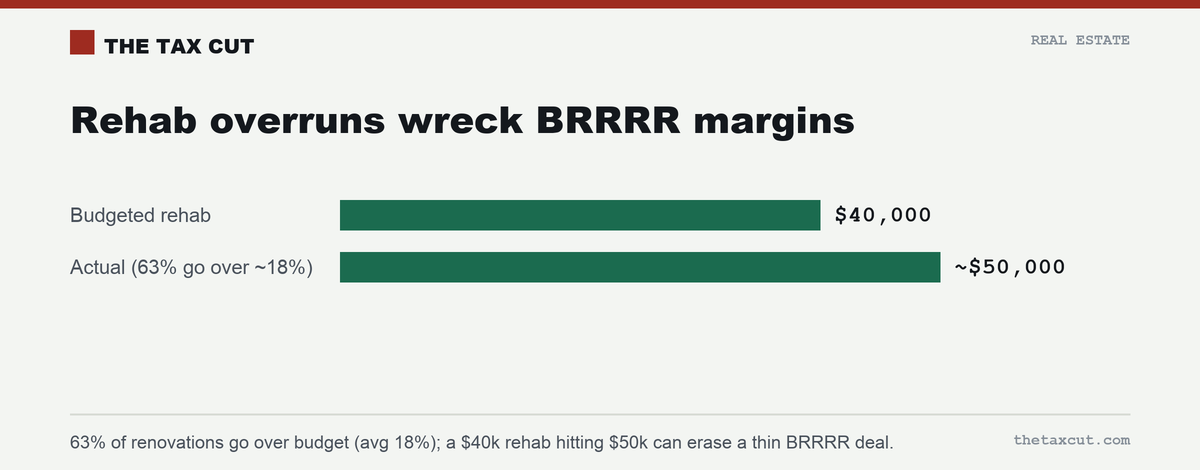
63% of home renovation projects go over budget, by an average of 18%. For a flipper that’s a haircut; for a BRRRR investor with tight margins, a $40,000 rehab that becomes $50,000 can kill the deal — because it inflates your all-in basis above what the refinance appraisal supports, trapping even more cash. On top of that, lenders now require six months of PITI reserves per property at the portfolio level, and a 6-month seasoning period before you can refinance. The 2026 tolerance for sloppy underwriting has collapsed.
Source: Kiavi — Best real estate investment strategy 2026 · checked 2026-07-29
Where BRRRR still works — and where it doesn’t
- It still works for disciplined operators who buy well below value, control rehab costs, and accept realistic (often break-even initial) cash flow — the forced appreciation still builds equity.
- Market-dependent: hot markets like Denver, Austin, and Phoenix don’t support traditional BRRRR economics in 2026 — the numbers only work in the right markets.
- Cash flow is often thin initially — properties frequently break even at first; the return is equity and long-term appreciation, not day-one cash flow.
- Reserves and credit gates: 25% equity, 620+ credit, 50% max DTI, 6-month seasoning, and 6 months’ reserves per property.
So what does BRRRR really return in 2026?
- The refinance often won’t return all your cash — higher rates trap capital in the deal.
- 63% of rehabs go over budget (avg 18%) — enough to break a thin BRRRR deal.
- It’s market-dependent and cash flow is often break-even initially.
- It still works for the disciplined — buy right, control rehab, hold reserves — but the “infinite money” version is gone.
BRRRR is a legitimate, powerful strategy for building a rental portfolio — but 2026 stripped away the magic. Higher rates mean the refinance rarely recycles 100% of your capital, rehab overruns kill thin margins, and lenders demand real reserves. Judge it by how much cash you actually get back at refinance and whether the deal cash-flows after a 7% loan — not by the “repeat with the same money forever” pitch. Done with discipline in the right market, it builds wealth; done on the old assumptions, it traps your capital one door at a time.
People also ask
Does the BRRRR strategy still work in 2026?
Yes, for disciplined investors — but the “pull all your cash back out” premise is broken by 7%+ rates. The refinance often returns well under 100%, leaving capital trapped, and it only works in the right markets.
Source: Kiavi — BRRRR 2026 · checked 2026-07-29
Why is BRRRR harder in 2026?
Higher-for-longer interest rates (7%+) shrink refinance proceeds and raise DSCR hurdles, so you can’t pull all your capital back out. Lenders also require 6 months’ reserves per property and a 6-month seasoning period.
What is the biggest risk in BRRRR?
Two: a refinance that returns less cash than expected (trapping your capital), and renovation overruns — 63% of rehabs go over budget by ~18%, which on thin BRRRR margins can kill the deal.
How much cash do you need for a BRRRR deal?
Roughly $93,000 per door (25% down on a ~$372,000 home plus rehab), and you need 25% equity, a 620+ credit score, and reserves — with the risk that not all of it comes back at refinance.
See it for your own numbers
Every calculator shows revenue. This one shows what lands.
Related on The Tax Cut
- How much do house flippers really make? — the flip version, with its own rehab-overrun risk.
- What does a rental property actually cash flow? — the cash-flow reality every BRRRR door has to clear.
- What is the 50% rule in real estate? — the expense screen that keeps a BRRRR rental honest.