The ATM business is pitched as the purest passive income there is: buy a machine, drop it in a busy store, and collect a few dollars every time someone withdraws cash. It’s genuinely one of the more hands-off small businesses — but “passive” hides two things: the modest per-machine number, and the pile of your own cash sitting inside each machine. Here’s what an ATM really makes.
What one machine earns
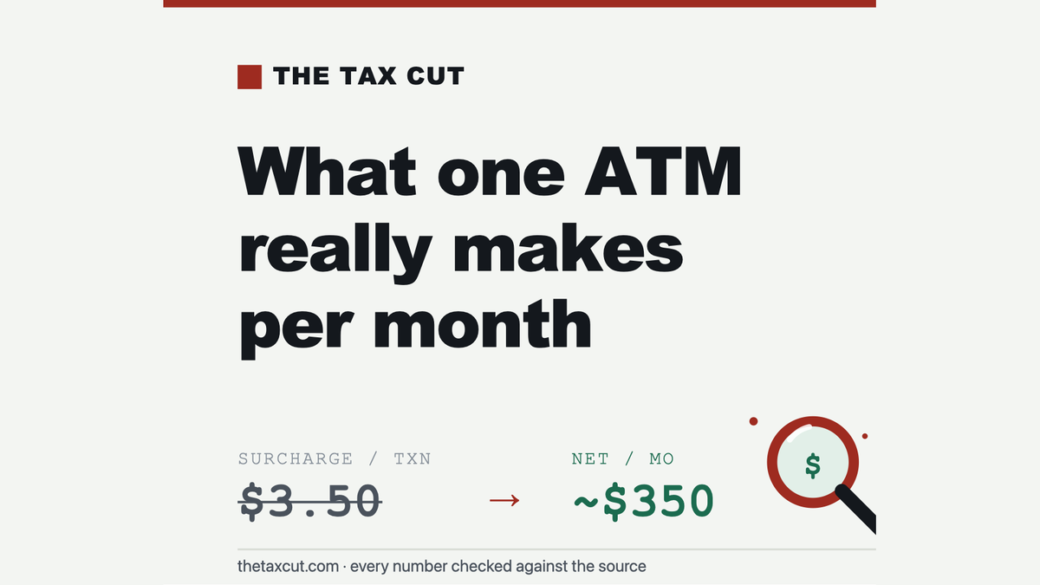
You make money on the surcharge — the fee charged per withdrawal, now averaging about $3.50 (up from $2.97 in 2017). An average independently placed ATM does 150–300 transactions a month.
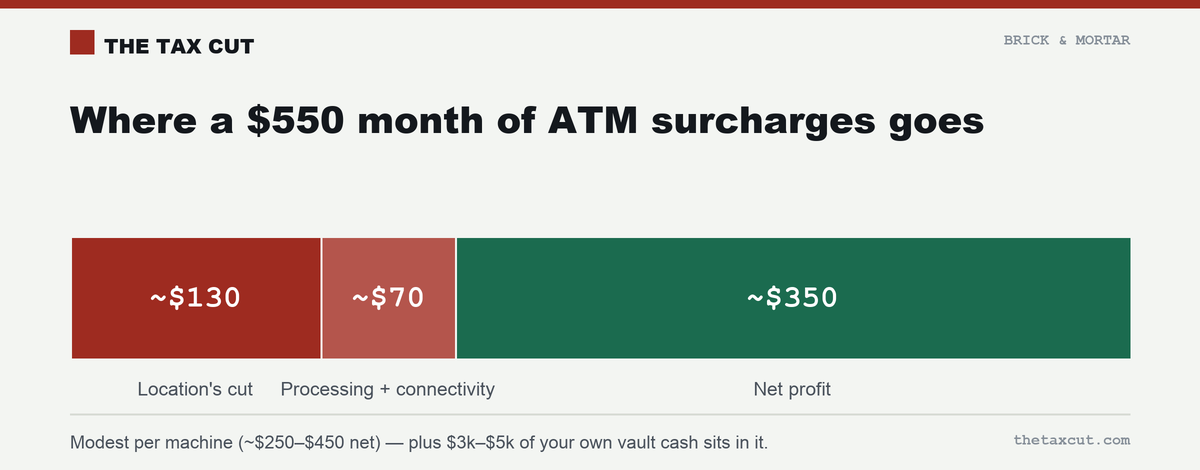
Take a decent location doing ~160 transactions at $3.50 = ~$550 in surcharge revenue. After the location’s revenue share ($0.50–$1.00 per transaction), processing ($20–$50/month), and cellular connectivity ($15–$25/month), you net around $350 — squarely in the typical $250–$450 per machine per month range. A quiet spot nets $200; a busy 24/7 location (gas station, bar, casino) can clear $1,500–$3,000+.
Source: ATM Depot — Is an ATM business still profitable? (2026) · checked 2026-07-29
The cost the “passive” pitch skips: your vault cash
Here’s what makes ATMs different from other passive plays. The cash people withdraw is your cash. Each machine needs an initial load of $3,000–$5,000, and that money sits in the machine, unavailable, until it’s dispensed and settled back to you. It’s not an expense, but it is capital tied up per machine — and you’re the one who has to drive out and refill it when it runs low.
So “passive” means: no employees and no daily grind, but real cash-management work — monitoring balances, restocking, reconciling, and fixing the occasional jam or outage. Semi-passive is the honest label.
Why it’s a route business
One machine at ~$350/month is a nice little add-on. Real income comes from scale:
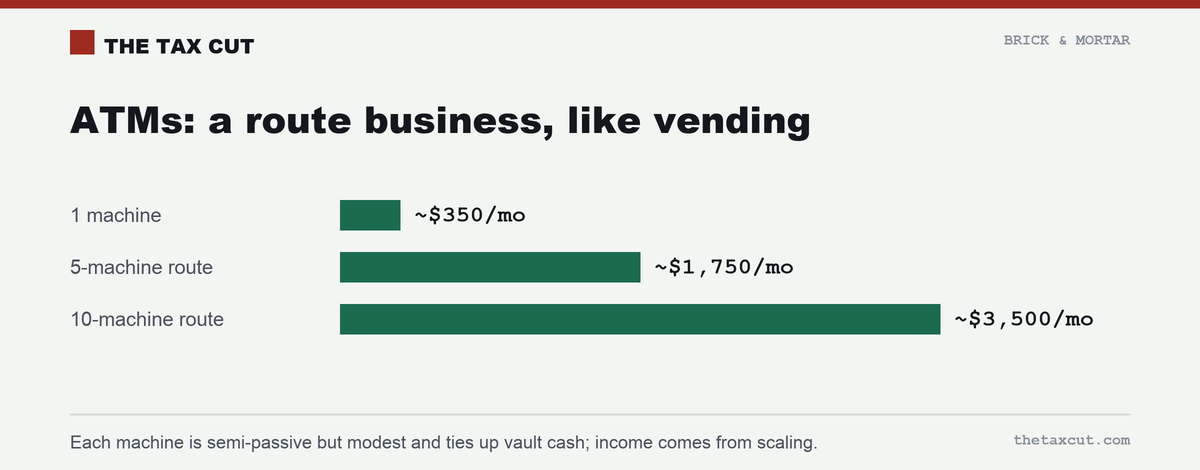
Like vending machines, the model scales linearly: a 5-machine route nets ~$1,750/month, a 10-machine route ~$3,500. But every machine you add ties up another $3,000–$5,000 in vault cash and another location relationship to manage. The machine typically pays for itself in 6–12 months; the vault cash is a standing commitment.
So is an ATM business worth it?
- Per machine: ~$250–$450/month net (great locations $1,500–$3,000+), semi-passive.
- Capital tied up: $3,000–$5,000 of your vault cash per machine, plus a $2,000–$8,000 machine.
- The work is cash management — restocking, monitoring, reconciling — not daily labor.
- The income is a route — one machine is a side trickle; a route of 10+ is a real income.
An ATM business is one of the more genuinely semi-passive small businesses — but it’s a capital business, not a magic box. You’re essentially renting out your own cash for $3.50 a withdrawal and doing the logistics to keep it stocked. Judge it by net-per-machine times the number of good locations you can fund and service — modest per machine, meaningful as a route.
People also ask
How much does an ATM make per month?
Typically $250–$450 per machine after the location’s cut, processing, and connectivity — on 150–300 transactions at a ~$3.50 surcharge. High-traffic 24/7 locations can clear $1,500–$3,000+.
Source: ATM Depot — ATM profitability · checked 2026-07-29
Is an ATM business really passive income?
Semi-passive. There are no employees, but you supply and refill the cash, monitor balances, and handle outages — real cash-management work, just not daily labor.
How much cash do you need to stock an ATM?
An initial vault-cash load of $3,000–$5,000 per machine, which sits in the machine until withdrawn and settled back to you — capital tied up, plus the $2,000–$8,000 cost of the machine itself.
How many ATMs do you need to make a living?
Since each nets ~$250–$450/month, a full-time income takes a route — roughly a 10-machine route nets ~$3,500/month, and each machine ties up its own vault cash.
See it for your own numbers
Every calculator shows revenue. This one shows what lands.
Related on The Tax Cut
- How much does a vending machine really make? — the identical “modest per unit, real as a route” model.
- Junk removal profit: what a $425 job nets — another local business where scale is the income.
- Food truck profit margins — a louder top line with a quieter bottom line.