Land flipping has the most eye-popping return numbers in real estate: buy a vacant parcel for a fraction of its value, sell it in a couple of months, and pocket a 150–500% ROI with no rehab and almost no carrying cost. The percentages are real. What they hide is that land flipping isn’t really a real-estate business — it’s a direct-mail marketing business where the “flip” is the easy part and finding the deal is everything. Here’s what land flipping really pays.
The deal math is genuinely good
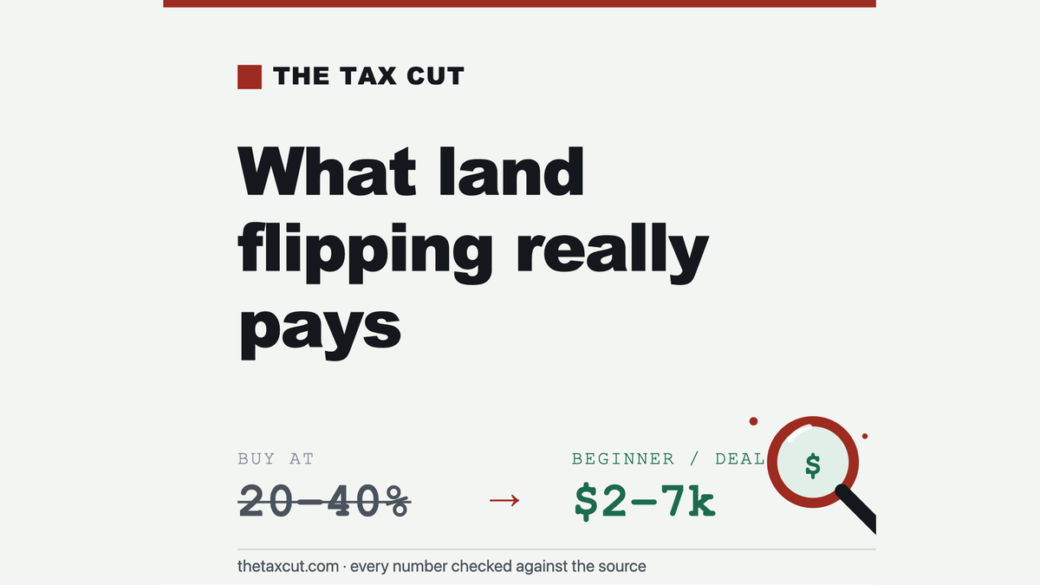
The model is simple and the margins are real: buy raw land at 20–40% of market value from a motivated seller, then resell near full value.
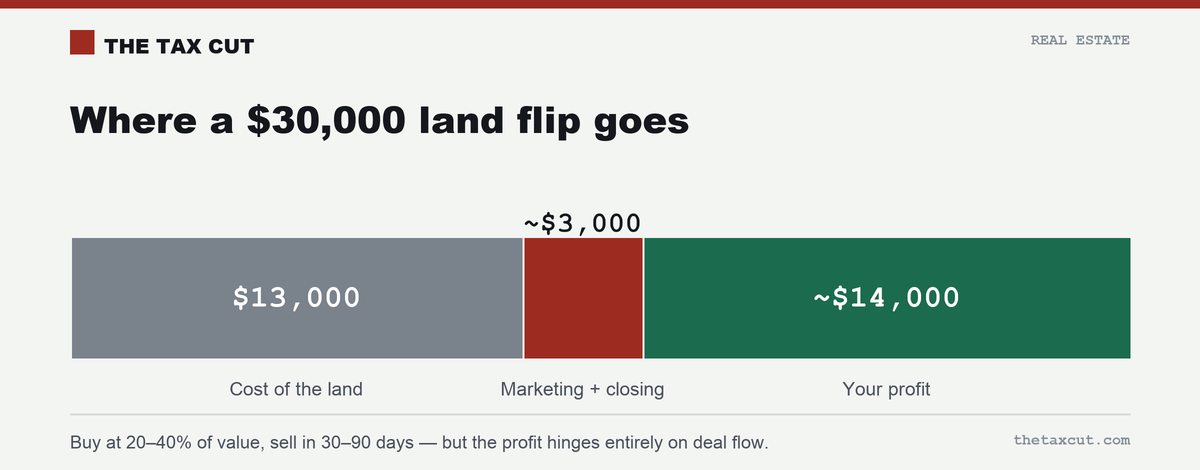
Take a parcel worth $30,000. Buy it for $12,000–$15,000, sell for $25,000–$30,000, and after marketing and closing costs you net around $14,000 — a huge percentage return, and land has almost no carrying cost (just low property taxes, no structures to maintain). Most flips close in 30–90 days. On paper, few things beat it.
Source: Landydandy — Is land flipping profitable? Real ROI data (2026) · checked 2026-07-29
The percentages hide the dollars — and the work
Here’s the reframe. A 300% ROI sounds life-changing until you see the absolute numbers for most people doing it.
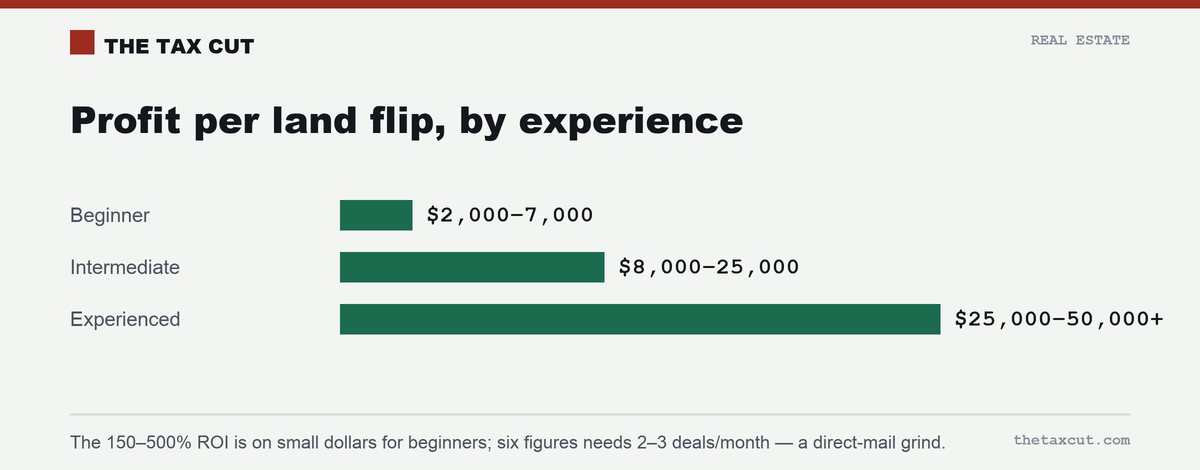
Beginners typically net $2,000–$7,000 per deal; intermediate flippers $8,000–$25,000; experienced investors doing larger parcels $25,000–$50,000+. Reaching six figures takes 2–3 deals a month — and that’s the catch, because getting deals is a volume marketing operation, not a treasure hunt. You mail hundreds or thousands of letters to landowners, hoping a small fraction sell at 20–40% of value. The “150–500% ROI” is on relatively small dollar amounts for beginners, and the profit is entirely gated by deal flow.
Source: Real Estate Skills — Land flipping 101 (2026) · checked 2026-07-29
The risks the ROI number skips
- Deal sourcing is the whole business. Direct mail, cold outreach, and skip tracing cost real money and time — spent whether or not a deal closes, exactly like wholesaling.
- Liquidity risk. Raw land can be slow to sell; a parcel priced wrong or in a weak location can sit for months, tying up your capital (or seller-financing it out slowly).
- Valuation is hard. Rural vacant land has thin comps — misjudge value and the “20–40% of market” deal isn’t one.
- It’s taxable business income, often with self-employment tax on active flipping.
So is land flipping worth it?
- ROI: genuinely high — 150–500%, buying at 20–40% of value with minimal carrying cost.
- Profit per deal: beginners $2,000–$7,000; experienced $25,000–$50,000+.
- Six figures requires 2–3 deals a month — a direct-mail sourcing grind.
- The business is marketing, not flipping — deal flow, valuation, and liquidity are the real work.
Land flipping is a legitimate, high-percentage niche — the returns are real and the carrying costs are refreshingly low. But it’s a marketing business wearing a real-estate costume: the profit lives entirely in your ability to consistently source under-market parcels and resell them, not in the flip itself. Judge it by net dollars per deal and by whether you can run a mail campaign that produces steady deal flow — because without that, the 500% ROI is a return on zero deals.
People also ask
How much do land flippers make per deal?
Beginners typically net $2,000–$7,000 per deal, intermediate flippers $8,000–$25,000, and experienced investors $25,000–$50,000+. Reaching six figures a year takes roughly 2–3 deals a month.
Source: Landydandy — Land flipping profit · checked 2026-07-29
Is land flipping profitable in 2026?
Yes, with high ROI (150–500%) from buying raw land at 20–40% of value and reselling in 30–90 days. But the profit is gated by deal flow, and sourcing deals is a direct-mail marketing operation, not a treasure hunt.
How does land flipping work?
You find motivated landowners (usually via direct mail), buy vacant parcels well below market value (20–40%), and resell near full value. Land has almost no carrying cost, so the margin is mostly the buy-low spread minus marketing and closing.
What are the risks of land flipping?
Deal-sourcing costs (spent whether or not deals close), liquidity risk (raw land can be slow to sell), and hard valuation (thin comps on rural land). It’s a marketing-and-volume business with real capital and liquidity risk.
See it for your own numbers
Every calculator shows revenue. This one shows what lands.
Related on The Tax Cut
- How much do real estate wholesalers make? — the near-identical direct-mail, deal-flow business.
- How much do house flippers really make? — flipping with rehab, and its own gross-vs-net gap.
- What does a rental property actually cash flow? — the buy-and-hold alternative.