Every reseller eventually discovers estate sales, and for good reason: they’re the best sourcing channel going — better margins than thrift stores, more variety than garage sales, and far less competition than you’d expect. But sourcing is only half the business. A great $20 find that resells for $300 still has to run the same gauntlet every reselling business faces: platform fees, shipping, listing time, and taxes. Here’s the real math on estate sale flipping — the sourcing edge, and the resale reality.
The sourcing edge is real
Estate sales are where resellers find margin. A single sale can yield $500–$2,000 in resellable finds, and the pricing lets you buy well below resale value.
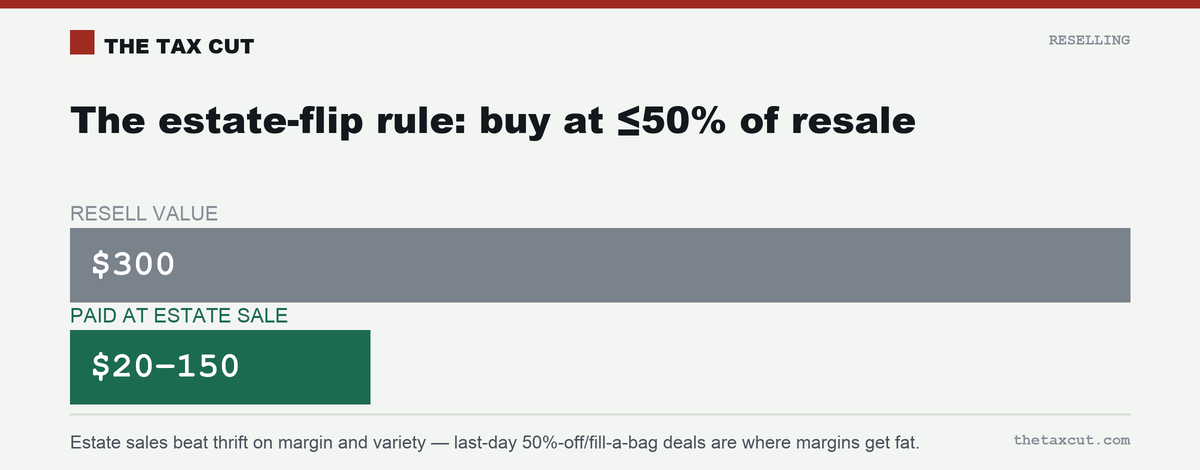
The rule experienced flippers follow: keep your all-in cost (item + transport) at 50% or less of the conservative resale price. That margin isn’t greed — it covers the reality of flipping: extra time, no-show buyers, hidden damage, and the occasional loss. And the timing hack: the last day of an estate sale often brings 50%-off or fill-a-bag deals, which is when margins get fat. The money is in jewelry, tools, vintage clothing, collectibles, electronics, and quality kitchenware — not the furniture everyone else fights over.
Source: Underpriced — Estate sale flipping strategy guide (2026) · checked 2026-07-29
But the resale gauntlet is the same
Here’s what the “$20 into $300” headline skips. Sourcing cheap is necessary but not sufficient — the profit still has to survive the sale.
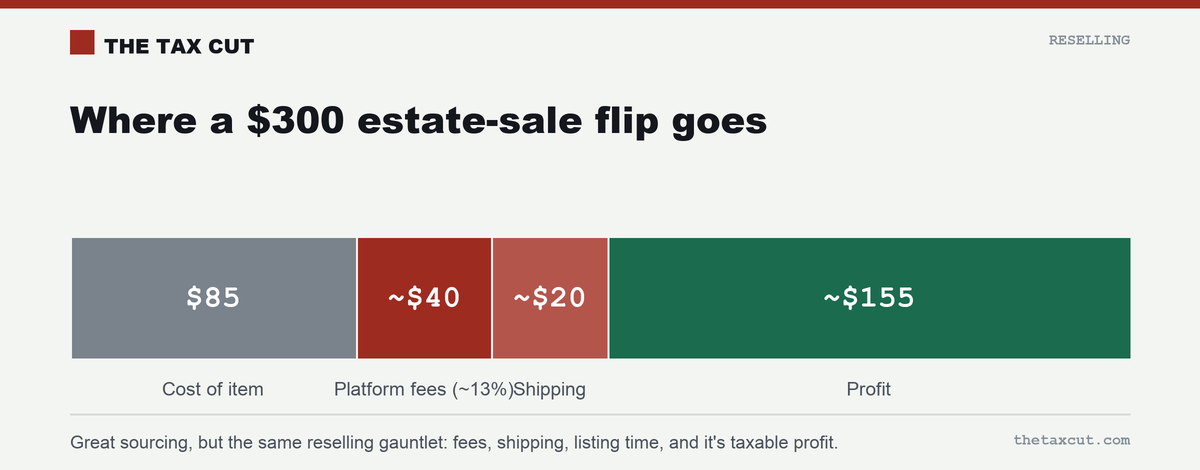
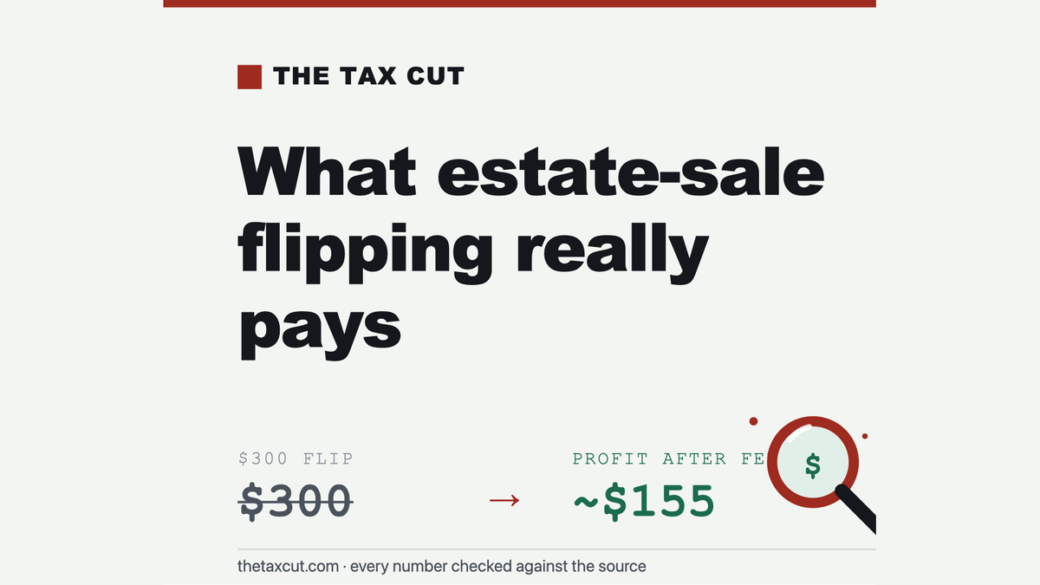
On a $300 sale, your item cost (~$85), platform fees (eBay’s ~13%, ~$40), and shipping (~$20) come out, leaving roughly $155 profit — before your listing and packing time, and before tax. It’s a strong margin, but it’s not $280, and the per-item labor (researching, photographing, listing, shipping) is the same grind as any reselling business. Estate sales make the buy side excellent; they don’t change the sell side.
The costs and caveats
- Sourcing time and gas. Mapping routes, arriving early on day one, and driving to multiple sales is unpaid time.
- Transport and storage. Bulky items need a vehicle and space; furniture especially can eat your margin in logistics.
- Platform fees and shipping — the same ~13% eBay cut and postage as any flip.
- Taxes. Profit is taxable: buy $5,000 of items and sell for $15,000, and you’re taxed on the $10,000 gain (minus shipping, supplies, mileage, and fees).
So is estate sale flipping worth it?
- Sourcing: the best channel for resellers — buy at ≤50% of resale, with fat last-day deals.
- Per flip: a $300 sale nets ~$155 after item cost, fees, and shipping — before time and tax.
- The edge is the buy side (cheap, varied, low competition); the sell side is the usual gauntlet.
- Time and logistics (sourcing, listing, shipping, storage) are the real limiters.
Estate sale flipping is a genuinely smart reselling strategy — the sourcing margins beat thrift and the last-day deals are real. But it’s a sourcing edge, not a different business: the profit still runs through fees, shipping, listing time, and taxes, exactly like flipping sneakers or thrift finds on eBay. Buy at half of resale, focus on high-value small items, and price the sell-side gauntlet in — then the $20-to-$300 finds actually add up.
People also ask
How much can you make flipping estate sale items?
A single estate sale can yield $500–$2,000 in resellable finds. Per item, buy at ≤50% of resale — a $300 flip nets roughly $155 after item cost, ~13% platform fees, and shipping, before your time and tax.
Source: Underpriced — Estate sale flipping · checked 2026-07-29
What sells best from estate sales?
Jewelry, tools, vintage clothing, collectibles, electronics, and quality kitchenware — the smaller, high-value items — not the furniture most buyers compete over.
Are estate sales better than thrift stores for reselling?
Yes for sourcing — better margins, more variety, and less competition. But the resale economics (platform fees, shipping, listing time, taxes) are the same as any flip.
How do you price items to flip from estate sales?
Keep your all-in cost (item plus transport) at 50% or less of a conservative resale price. That margin covers extra time, no-show buyers, hidden damage, and occasional losses.
See it for your own numbers
Every calculator shows revenue. This one shows what lands.
Related on The Tax Cut
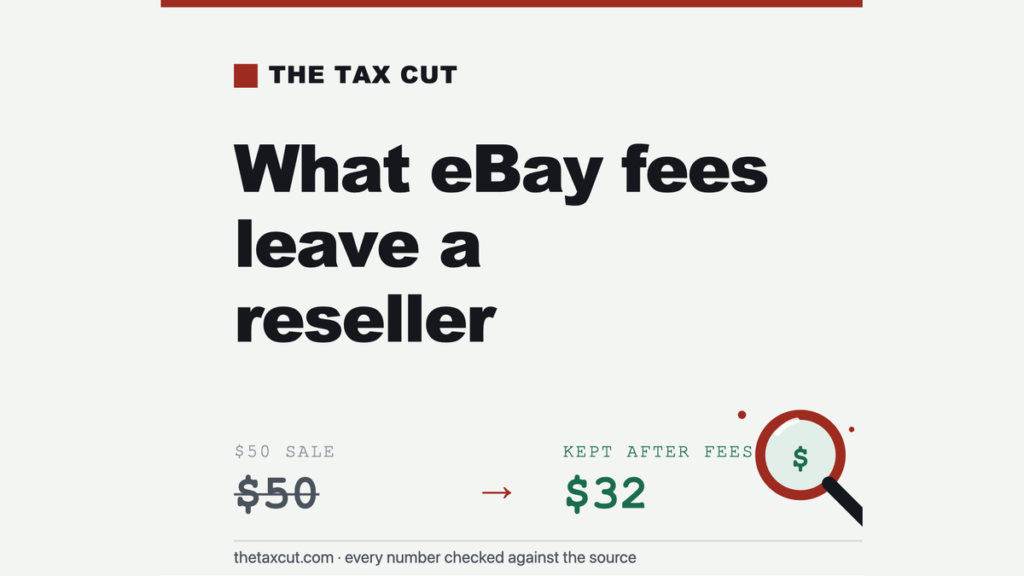
- eBay fees: what a $50 flip nets — the sell-side fee gauntlet, in detail.
- How much do sneaker resellers actually profit? — fee-minus-cost math on another flip.
- Do you pay taxes reselling sneakers? — how reselling profit is taxed, estate-sale flips included.