Airbnb arbitrage is sold as real estate without the real estate: rent an apartment, furnish it, list it on Airbnb, and pocket the spread — no down payment, no mortgage, no property. The spread is real. What the pitch buries is the other side of “no property”: you don’t own the asset, but you’re on the hook for the rent every single month, whether a guest ever books or not. Here’s the real math, and the number that decides everything.
The monthly P&L
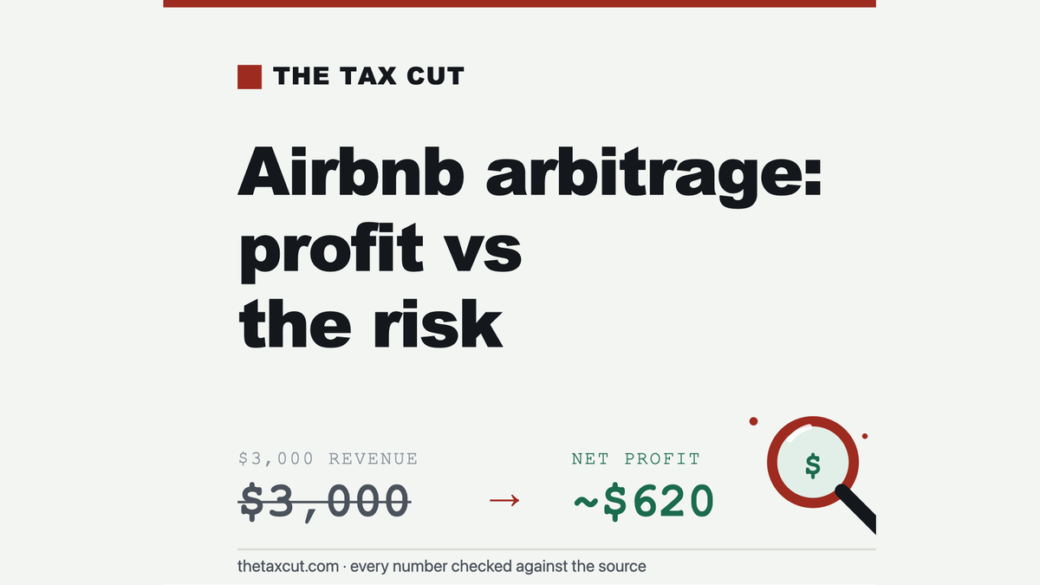
Take a unit renting for $1,500 that grosses $3,000/month on Airbnb — a solid arbitrage setup.
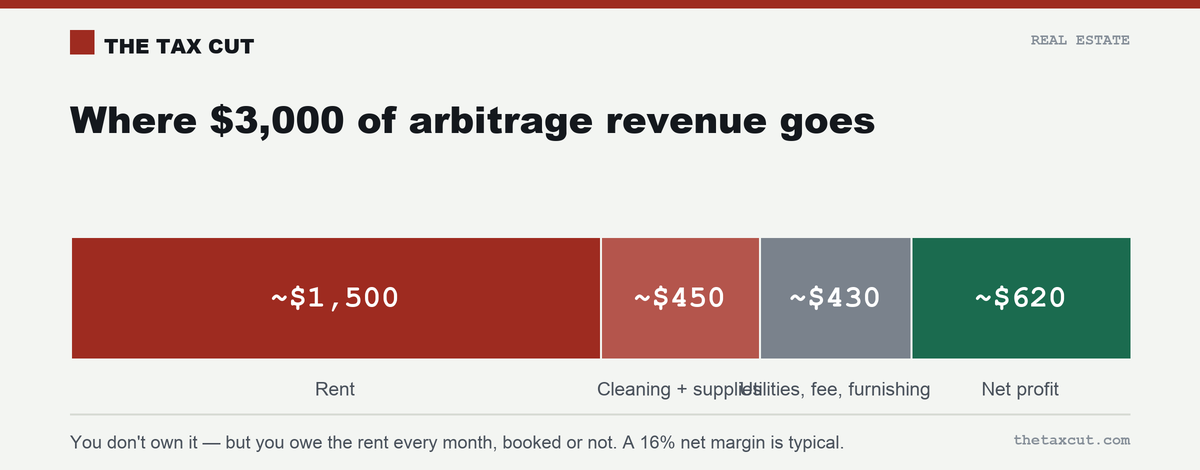
After rent (~$1,500), cleaning and supplies (~$450, the biggest variable cost at $75–$150 a turnover), and utilities, the Airbnb host fee, and furnishing amortization (~$430), you’re left with about $620 — a 16% net margin. A healthy arbitrage unit runs 15–25% of gross, and most clear $1,000–$1,500/month, with strong units hitting $2,000–$5,000.
Source: AirROI — Airbnb arbitrage unit economics (2026) · checked 2026-07-29
That’s a genuinely good return on a few thousand dollars of startup capital — if the calendar cooperates. The whole business hinges on whether it does.
The number that kills first-timers: break-even occupancy
Here’s what separates arbitrage from owning a rental. A landlord with a vacancy loses potential income. An arbitrageur with a vacancy still owes the full rent. So there’s a hard occupancy floor you have to clear just to not lose money.
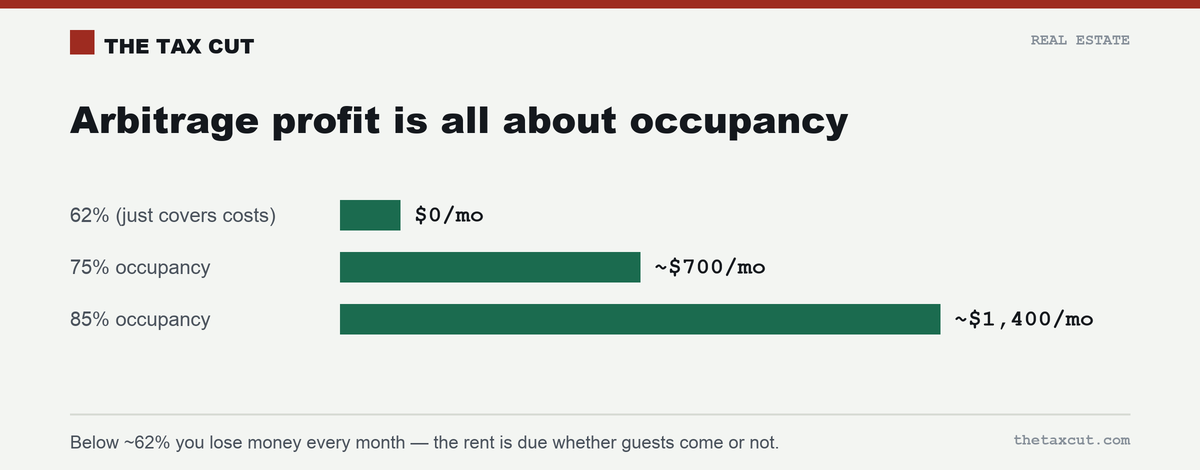
The median US arbitrage unit needs roughly $4,200 in startup capital and 62% occupancy just to cover rent, utilities, and platform fees. Below that line, you’re paying out of pocket to run someone else’s apartment. Above it, every extra booked night is nearly pure profit. That 62% break-even “kills more first-time operators than any other single variable” — a slow season or a new competitor down the street can push you under it fast.
Source: AirROI — Airbnb rental arbitrage 2026: where the margins still work · checked 2026-07-29
The risks the spread hides
- You owe rent in the empty months. No booking, no revenue — but the landlord still gets paid. Thin margins (<10%) can't absorb a bad month.
- Furnishing is real upfront cash. $4,000+ to furnish, and if the arrangement ends, you’re moving furniture, not selling an asset.
- Regulation risk. Cities are tightening short-term-rental rules; a rule change can end a unit overnight — and you don’t own it to pivot.
- Landlord permission. Doing this without the landlord’s written OK risks eviction and lost furnishing. Legit arbitrage requires their sign-off.
So is Airbnb arbitrage worth it?
- Per unit: $1,000–$1,500/month net is typical (15–25% margin); strong units reach $2,000–$5,000.
- The catch: you owe the rent every month, and need ~62% occupancy just to break even.
- Low capital, real risk: ~$4,200 to start, but a slow season means paying to run an apartment you don’t own.
- It’s an operations business, not passive real estate — occupancy management is the whole job.
Airbnb arbitrage can genuinely pay — the margins still work in the right markets. But it’s a leveraged bet on occupancy, not an asset that appreciates while you sleep. Model it at 62% break-even, not at “fully booked,” and keep a cushion for the months the calendar goes quiet — because the rent won’t.
People also ask
Is Airbnb arbitrage profitable in 2026?
Yes in the right market — most units net $1,000–$1,500/month (15–25% margin), strong ones $2,000–$5,000. But you owe the rent every month and need ~62% occupancy just to break even.
Source: AirROI — Arbitrage unit economics · checked 2026-07-29
How much does it cost to start Airbnb arbitrage?
The median unit needs about $4,200 in startup capital — mostly furnishing, deposits, and first month’s rent — plus the ongoing rent you owe whether the unit books or not.
What is the break-even occupancy for Airbnb arbitrage?
Around 62% for the median US unit — the occupancy needed just to cover rent, utilities, and platform fees. Below it, you lose money every month.
Is Airbnb arbitrage risky?
Yes. You owe the full rent in empty months, furnishing is sunk cost, short-term-rental regulations can end a unit overnight, and you need the landlord’s written permission to do it legally.
See it for your own numbers
Every calculator shows revenue. This one shows what lands.
Related on The Tax Cut
- What does an Airbnb host actually keep? — the owner’s version of the same short-term-rental math.
- What does a rental property actually cash flow? — owning vs. arbitraging, side by side.
- Is Turo worth it with a financed car? — another “payment due whether it earns or not” bet.