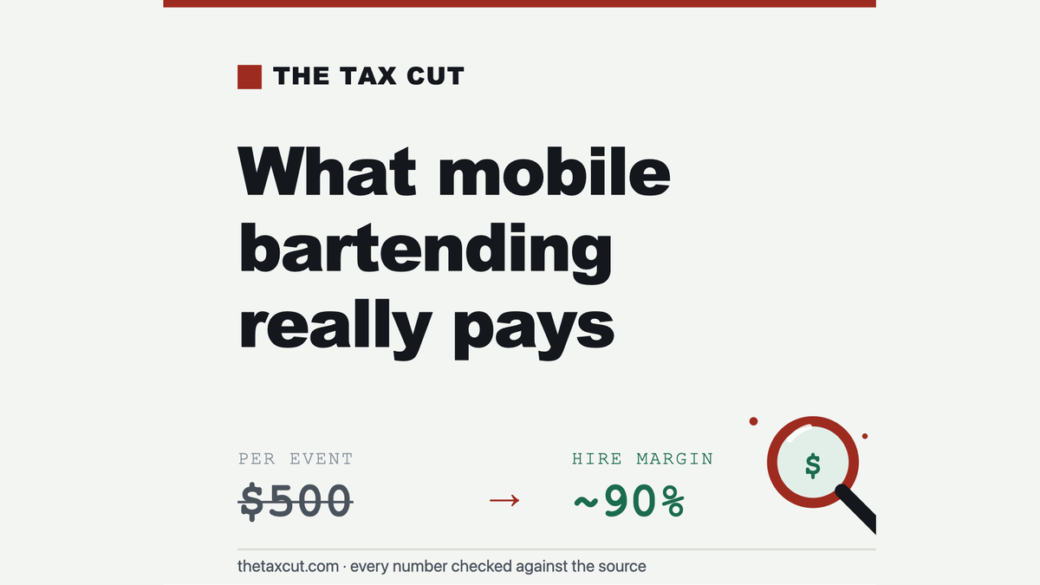
Mobile bartending is one of the rare event businesses where the honest numbers are better than the pitch — but only if you pick the right model. The choice between being a bartender for hire (the client buys the booze, you bring the skills) and running a full-service bar (you supply everything) is the whole ballgame: one runs at ~90% margins, the other at 20–40%. Here’s what mobile bartending really makes, and why the model matters more than the menu.
The model decides the margin
The single biggest lever isn’t your cocktails — it’s who buys the alcohol.
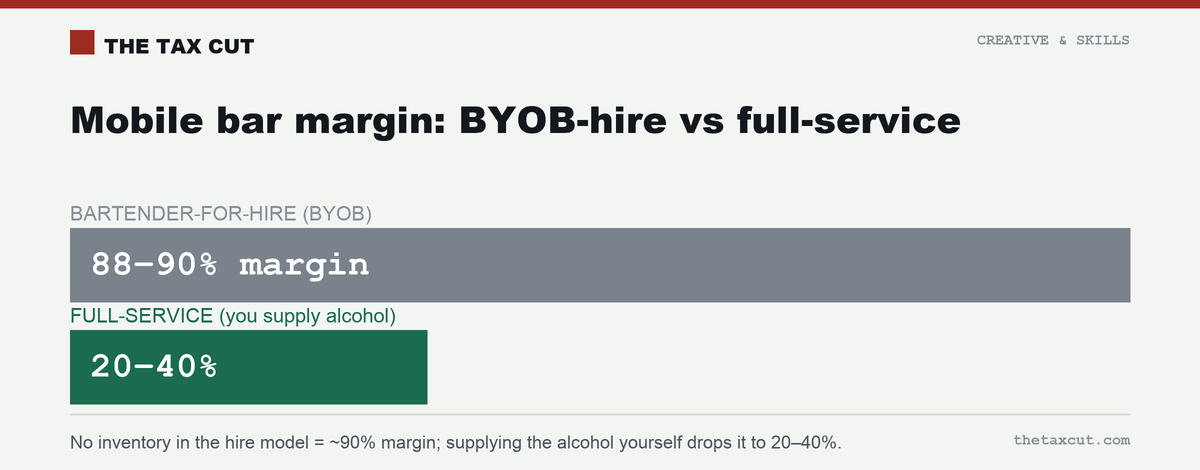
Bartender for hire — where the host provides the alcohol and you provide bartending, bar setup, mixers, and service — runs 88–90% profit margins, because you carry almost no inventory cost. A full-service bar, where you buy and supply the alcohol, drops to 20–40% as the cost of goods eats the margin. Same event, same skills — but the hire model keeps two to three times more of every dollar, which is exactly why it’s the model to start with.
Source: Mobile Bev Pros — How to price mobile bar services (2026) · checked 2026-07-29
The per-event and annual numbers
On the hire model, the economics are excellent for a service business.
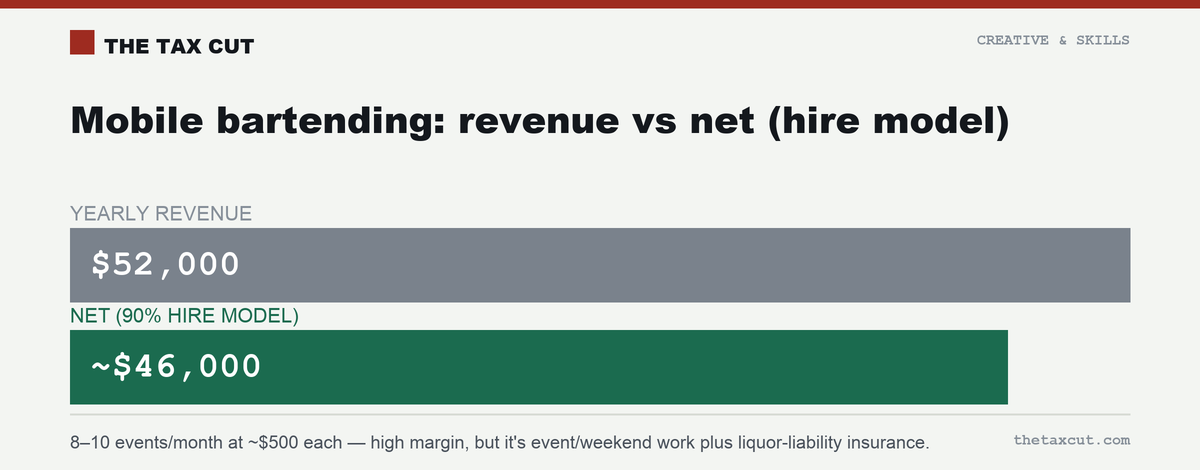
Mobile bartenders typically make around $500 per event (roughly $50/hour) at that ~90% margin. Annual revenue for mobile bars ranges $52,000–$260,000, and booking 8–10 events a month generates a monthly gross profit of $4,800–$6,000. At the low end, $52,000 in revenue is nearly $46,000 in net profit on the hire model — a rare business where the top line and the bottom line are close together, precisely because there’s no inventory.
Source: Progressive Pours — How much a mobile bartending business makes (2026) · checked 2026-07-29
The costs and caveats the margin hides
- Liquor liability insurance. Non-negotiable when alcohol is involved — $150–$600/year for basic coverage, up to $2,500 for full packages, or ~$275 for a single 1–3 day event.
- Licensing and certification. Bartending/alcohol-service certifications and, depending on the state, permits.
- It’s event/weekend work. Like DJing and photography, bookings cluster on weekends and around event season — the annual depends on booking volume.
- The labor is you. High margin, but you (or hired bartenders) work every event; scaling means staff, which adds cost.
So is mobile bartending profitable?
- Bartender for hire (client supplies alcohol): ~88–90% margin — a $500 event is nearly all profit.
- Full-service (you supply alcohol): 20–40% margin — cost of goods eats it.
- Annual: $52,000–$260,000 revenue; 8–10 events/month = $4,800–$6,000/month gross profit.
- The catches: liquor-liability insurance, certification, and weekend/event-based booking volume.
Mobile bartending is one of the genuinely better event businesses — the bartender-for-hire model has almost no inventory cost, so ~90% of what you charge is profit. The keys are simple: start with the hire model (let the client buy the alcohol), carry proper liquor-liability insurance, and book enough events to fill your weekends. Do that, and it’s a rare high-margin service where revenue and take-home are nearly the same number.
People also ask
How much do mobile bartenders make?
About $500 per event (~$50/hour) at ~90% margin on the bartender-for-hire model. Annual revenue ranges $52,000–$260,000; booking 8–10 events a month yields $4,800–$6,000/month gross profit.
Source: Progressive Pours — Mobile bartending income · checked 2026-07-29
Why is bartender-for-hire more profitable than a full-service bar?
Because the client buys the alcohol, so you carry almost no inventory cost — margins run 88–90%. Supplying the alcohol yourself (full-service) adds cost of goods and drops the margin to 20–40%.
Do mobile bartenders need insurance?
Yes — liquor liability insurance is essential when serving alcohol. It runs $150–$600/year for basic coverage (up to $2,500 for full packages), or about $275 for a single 1–3 day event.
Is a mobile bartending business worth it?
Yes, on the hire model — it’s high-margin (~90%) with low startup and no inventory. The limiters are booking volume (it’s weekend/event work), liquor-liability insurance, and certification requirements.
See it for your own numbers
Every calculator shows revenue. This one shows what lands.
Related on The Tax Cut
- How much do wedding DJs make? — another event business with weekend concentration and its own real costs.
- Food truck profit margins — the opposite trade-off: high revenue, thin margin from cost of goods.
- Bounce house rental profit — an event-rental business judged on the real, hands-on work.