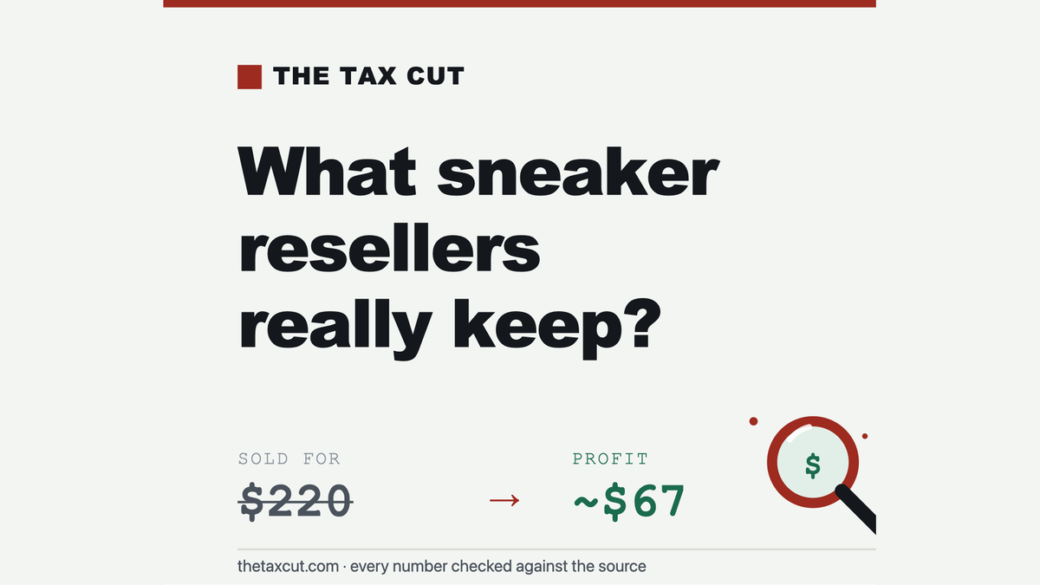
Sneaker reselling is sold on one screenshot: “Bought for $110, sold for $220.” A clean double. What the screenshot never shows is the payout — the number that actually hits your account after StockX takes its cut, the processor takes another, shipping comes out, and the pair you already paid for is subtracted back off.
So let’s answer the question resellers ask after their first sale, not before it: how much do sneaker resellers actually profit? With StockX’s own fees and the costs the “sold for” number hides.
What StockX takes from a sale
Start with the platform cut. StockX charges a transaction fee set by your Seller Level, plus a flat 3% payment processing fee, plus shipping.
$220 Sale price−$22 Transaction fee (L1 10%)−$6.60 Processing 3%≈−$14 Shipping
New sellers start at Level 1 = 10.0%, dropping with quarterly sales volume — 9.0% at Level 3, 8.5% at Level 4, and as low as 5% at Level 5 with Quick-Ship and Successful-Ship bonuses. A small bank/payout fee (~$2) can apply too.
Source: StockX Help — What are StockX’s fees for Sellers? · checked 2026-07-28
Source: StockX Help — Seller Program & Seller Levels · checked 2026-07-28
So on a $220 pair, a Level 1 seller nets a payout around $177 before the shoe itself is subtracted. GOAT is similar — roughly 9.5% commission plus a 2.9% cash-out fee — which is why serious resellers route pairs by platform rather than marrying one.
The cost the “sold for” number quietly subtracts
Here’s where the screenshot stops. That $177 payout isn’t profit — you still have to pay yourself back for the pair.
$177 Payout−$110 Cost of the pair≈$67 Gross profit~30% On a $220 sale
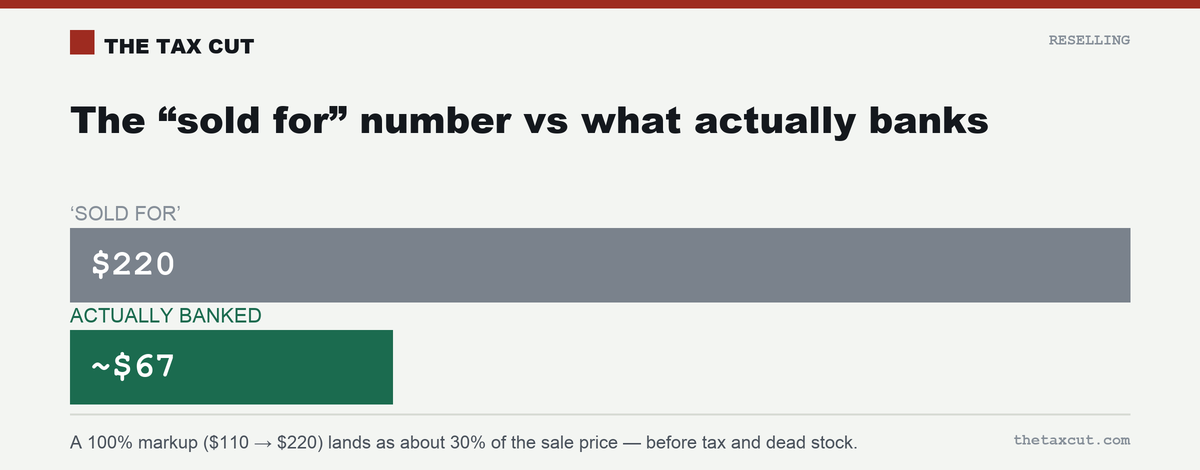
A “$110 → $220 double” is really about $67 in the hand — before tax. The fees didn’t just trim the profit; they turned a headline 100% markup into roughly a 30% margin on the sale price. And that’s the good case: a pair that sold quickly, at the price you wanted.
The three things that turn $67 into $0
1. Pairs that don’t sell. the silent killer Reselling only works on pairs the market wants at a premium. Guess wrong and a shoe sits at cost — or sells at a loss once you drop the price to move it. Your winners have to cover your dead stock.
2. Taxes. Resale profit is taxable income. Sell enough and you’ll get a 1099-K, and the IRS treats consistent flipping as a business — self-employment tax included. The $67 is pre-tax; the after-tax number is smaller.
3. Your time and cash. Sourcing, authenticating, photographing, shipping, and chasing releases is real labor, and your money is tied up in inventory that may take weeks to sell. Divide the profit by the hours and the cash locked up, and the effective return shrinks again.
Claimed against banked
A realistic flip, Level 1, after everything. illustration
$220 ‘Sold for’−$43 Fees + shipping−$110 Cost of pair≈$67 Banked (pre-tax)
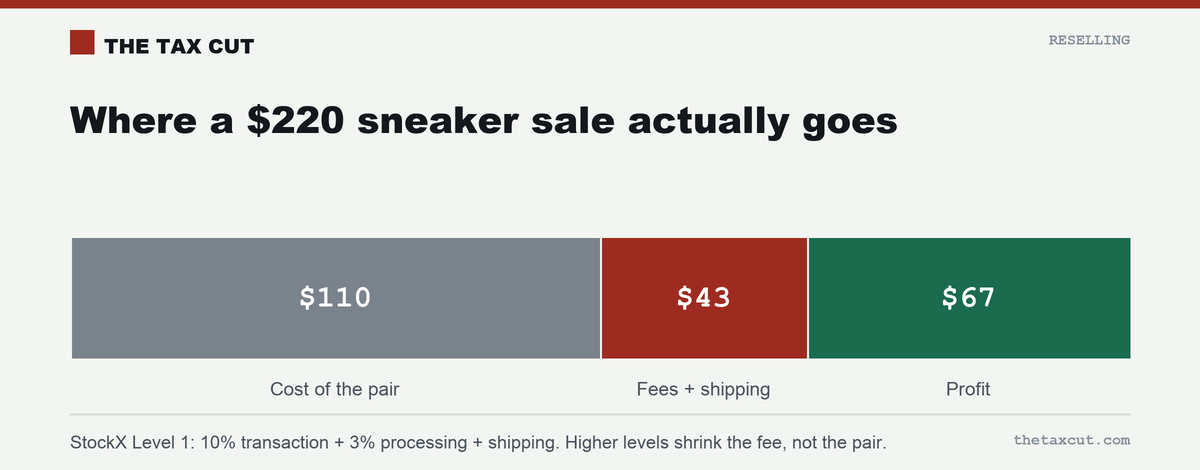
Every line is StockX’s stated fee or the shoe’s own cost — nothing exotic. The distance between “sold for $220” and “$67 in hand” is just the platform, the processor, the shipping, and the pair. Screenshot the first number and you look like a genius; bank the last one and you’ve made a solid — not spectacular — flip.
So how do the resellers who profit actually do it?
- They lower their fee by moving volume. Level 1’s 10% versus Level 4’s 8.5% is real money at scale — the pros grind their Seller Level down deliberately.
- They route by platform. Hyped deadstock to StockX, used/vintage to eBay, hands-off consignment to GOAT — matching each pair to the cheapest, fastest exit.
- They buy right, not just sell right. The profit is made at purchase — sourcing under market — not at sale. A pair bought at retail in a saturated size rarely clears a margin.
- They price in tax and dead stock from day one, so a good month of winners actually survives the losers and the IRS.
Sneaker reselling is a real hustle, but it’s a thin-margin retail business, not a money printer. The “sold for” number is the brochure. The payout minus the pair minus the tax is the paycheck — usually a fraction of what the screenshot implies.
People also ask
What are StockX seller fees in 2026?
A transaction fee by Seller Level (Level 1 starts at 10.0%, down to 8.5% at Level 4 and as low as 5% at Level 5 with bonuses), plus a flat 3% payment processing fee, plus shipping and a possible ~$2 payout fee.
Source: StockX Help — Seller fees · checked 2026-07-28
Is StockX or GOAT cheaper for sellers?
They’re close. Established sellers land near 9.5% on both. StockX charges a flat shipping fee; GOAT offers free shipping over $150 but adds a 2.9% cash-out fee. Route pairs by which is cheaper for that specific sale.
How much profit do sneaker resellers actually make per pair?
Often around 25%–35% of the sale price on a pair that sells at target — e.g. ~$67 on a $220 sale bought at $110 — before tax and before accounting for pairs that don’t sell.
Do I have to pay taxes on reselling sneakers?
Yes. Resale profit is taxable, you may receive a 1099-K, and consistent flipping is treated as a business, which adds self-employment tax. Set money aside from every sale.
See it for your own numbers
Every calculator shows revenue. This one shows what lands.
Related on The Tax Cut
- What does a KDP book really make per month? — thin per-unit margins that only work at volume.
- Why most affiliate marketers make nothing — the online-income distribution nobody screenshots.
- How much does Twitch pay per sub? — a headline number split before you ever see it.