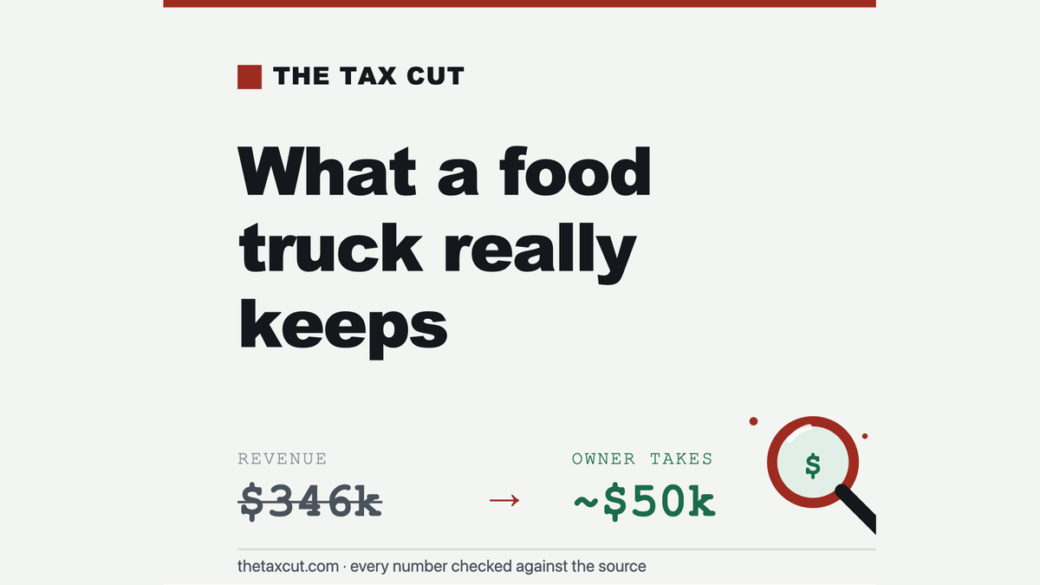
A food truck doing $346,000 a year sounds like a small fortune on wheels. Then you learn the average net margin is 6–9%, and that “fortune” becomes an owner-operator salary — one earned on your feet, in a hot truck, twelve hours a day. Here’s what a food truck really keeps, and where the other 90-plus cents of every dollar goes.
The revenue is real — the margin is thin
The average US food truck grosses around $346,000 a year, roughly $500–$2,000 a day. It’s the margin on that revenue that surprises people.
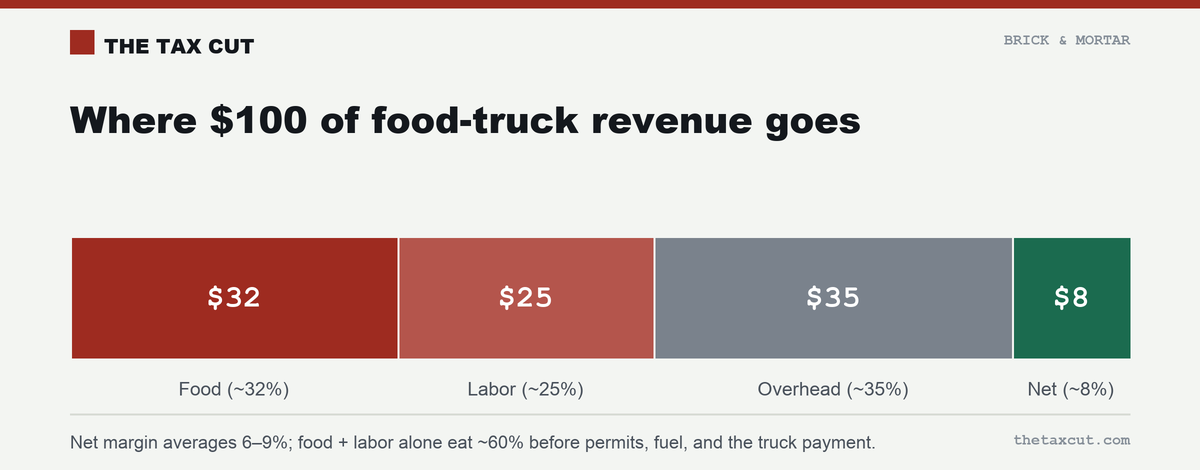
Most trucks run a net profit margin of 6–9% (well-run operations push past 15%). Two costs do most of the damage: food cost at ~28–35% of revenue, and labor at ~20–30% — together roughly 60% of the money before you’ve paid for anything else.
Source: Food Truck Empire — 2026 food truck statistics (margins & costs) · checked 2026-07-29
The costs hiding in the other 30%
Food and labor are just the two biggest. The rest of the overhead is a long, unglamorous list that quietly finishes off the margin:
- Commissary rent — most cities require a licensed commercial kitchen to prep and park.
- Fuel and maintenance — for both the truck and the generator.
- Permits, licenses, and insurance — renewed constantly, and location-specific.
- The truck payment itself — if financed, due whether you serve 40 customers or 400.
- POS fees, propane, packaging, and spoilage.
Add those and you’re at the ~90% of revenue that isn’t profit — which is how a $346,000 top line becomes a five-figure take-home.
What the owner actually takes home
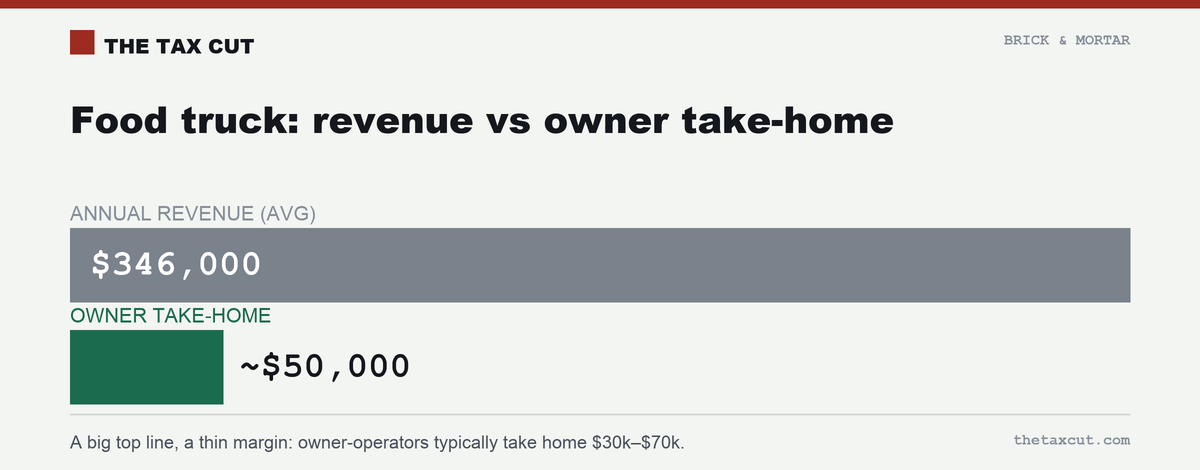
Owner-operators typically take home $30,000–$70,000 a year; well-run trucks that lean into catering and repeat customers can clear $50,000–$150,000+. But note what that pay includes: the owner is usually also the cook, the driver, the dishwasher, and the bookkeeper. The “profit” is really a wage for a very long day — and in a slow season, a thin one.
So are food trucks worth it?
- Revenue looks huge (~$346k average) — but net margin is only 6–9%.
- Food + labor eat ~60% before overhead, permits, fuel, and the truck payment.
- Owner take-home: typically $30k–$70k; more with catering and efficiency.
- The take-home is a working wage, not passive profit — you are the staff.
A food truck can be a real, rewarding business — the successful ones obsess over food cost, lean into high-margin catering, and treat the 6–9% margin as something to defend every single day. Just don’t confuse the revenue with the profit: on a food truck, the top line is loud and the bottom line is quiet.
People also ask
What is a good food truck profit margin?
Average is 6–9% net; well-run trucks push past 15%. Food cost (~28–35%) and labor (~20–30%) are the two biggest expenses, together about 60% of revenue.
Source: Food Truck Empire — 2026 statistics · checked 2026-07-29
How much do food truck owners actually make?
Owner-operators typically take home $30,000–$70,000 a year; those who optimize catering and retention can reach $50,000–$150,000+. The pay reflects the owner also being the cook and driver.
How much revenue does a food truck make?
The US average is about $346,000 a year ($500–$2,000/day), with top performers exceeding $1 million — but the thin margin means revenue and profit are very different numbers.
What are the biggest food truck expenses?
Food cost (~28–35% of revenue) and labor (~20–30%) are the largest, followed by commissary rent, fuel, permits, insurance, and any truck financing.
See it for your own numbers
Every calculator shows revenue. This one shows what lands.
Related on The Tax Cut
- Vending machine profit: what one machine really makes — another food-service business where the margin hides in the costs.
- Mobile car detailing: the real hourly — a self-employed operation where you’re also all the labor.
- Why a $10,000 real-estate commission becomes ~$4,000 — another big gross number that shrinks to a modest take-home.